By E.K. Anderson
Genre: Gothic fantasy/Horror
August 3, 1950 – Chicago
–A momentary lapse of reason
I was out of sorts on the day I left my wife.
That day, I lied, as I had numerous times before. I told my wife that I was out with a few old college friends, having drinks at the local pub on Aberg Avenue. Gambling hadn’t come to the fore then, but I’m sure she had her suspicions. Her reasoning—and my defense–was that since I was born into a good Christian family, I would honor our marriage. I told her I would not cheat as ungodly men do, and this verbal affirmation lent credence to the claim. However, resolute I was in this affectation, this changed when I met the girl.
Everything changed after that.
For weeks, I’d been wrestling with the decision. Of course, like a demon’s possession, it only stirred my state, and darkened my mood. To stifle my state further, I began to drink with the vague illusion that between the glasses of scotch I’d find a revelatory notion to impede my doubts.But with the residual pang of suffering, I resolved to annul myself as one would an exorcism.
I called Hughes, from the theatre, and resolved that night to pack my suitcase, and leave for the last bus station of the night. The day I left our home, I knew I would never return. The body I occupied was miles away from the mental task I had set for it. I kept to mine most perfunctorily — brutishly set in the throes of my directorial work at the Guild.
My solitary nature of course, did not bode well for the discourse of our marriage — and my wife, being perceptive to my level of aloofness took to the seas of her adventure, without a word. I told her that I was going to complete my work, and that was that.
And then the thought came most immediately to jump and rid myself of the searing emptiness. I resolved to leave that night.
And leaving my ring upon her pillow, I left.
I’d been staying with an actor friend. (Squatting, was more so the word). Most days I’d set up my study in the basement of the theatre, typing away at something to rant about.
The following week, my wife’s letter came in the mail.
Good riddance, scum.
Off to meet a sailor in Prague.
Despite the inner calamity I felt, I did not question the conditions of her departure. I was a fool for allowing an open marriage, and my karmic self-indulgence had finally paid its pang due.
I set the envelope upon the desk of my study. The golden ring I’d set upon the pillow was smelted thin, hammered into a disc of flattened metal.
The day I left, I was still honing the particularities of the play. The Theatre’s production of a Midsummer’s Night Dream, had fallen through to me. As director, my task was to find an adequate substitute for Queen Titania. I suppose, I’d been looking for an excuse; a partial-solution to the slew of dreariness I’d been feeling lately.
I’d been writing on spec for the theatre’s production of a Midsummer’s Night Dream. But my inspiration started when I caught sight of her. On set for her audition, I saw the woman with the countenance of Circe. She drew breath, and I sat in stark admiration of her presence. I gave her the part.
*
The girl entered the Pub late one evening. It wasn’t that she’d entered by herself modestly. It was that she entered as majestic, and placidly as a moth. Allured by the woman’s appearance, I’d observed her from the inside of Lorcan’s pub, sheepishly. I was still married then, and my wife had been away on a directorial production. It was the anniversary of our wedding
Grateful for the shield of bodies from my other bar patrons I contented myself with a drink to celebrate the New Year. She sat languidly upon the patio bar bench, toting arm in arm alongside a young student from the Actor’s guild. In her hand was an Old Fashioned drink– sour or sweet — I could not tell. But from the restaurant’s veranda
Wan and scarlet-haired, she rose from the bench.She seemed like the compilation dreams were made of.
I ordered an Old Fashioned Sweet.
“Complements of the house,” Lorcan said. “Courtesies from Morgan Le Fey Celeste. On the house.”
“Interesting,” I said. “I will be sure to thank her.”
I was a Marlon Brando in those days. Beset by a bit of fame, I could play the lofty pride of the part. I was Flint O’Toole. A casanova on the rebound.
Morgan was an actress, or so she told me, and I believed her because she looked like Greta Garbo. She had sunshine in her eyes, and a voice that matched, which made me reminisce. When she spoke, I felt young again.
“My name’s Flint O’Toole,” I told her, my voice husky as tarnished leather. “Like the city in Michigan.” Hers was Celeste. I told her that I ran the actor’s guild.
“I’m a teacher,” I said.
“Of what sort? Theater?” The girl twirled her scarlet hair. The sprigs tumbled over her shoulders like a bloodied cataract. She popped her gum.
“No, history. Western Civilization. Ethics.”
“At the university?”
“Yes,” I said, “But I also direct in my free time.”
“Tell me about it.”
So I did. And she told me about her experience in showbiz, and how her long lost manager had sold her out for a blonde with knee high stockings. She’d resorted to waitressing, and dancing at the gentleman’s club part time. Her story was lavish and piteous, so I accepted most of it, subconsciously. I shunned from any mention of relationships, or my wife. With time I could tell her fondness for me had grown, so I asked her out.
I thought a simple dinner with a movie was sufficient. I took her to Caelum, a five star restaurant, with water carafes, and pallid, bored waiters.
As I sat across from her, I caught the smell of patchouli. Her smile was an effulgence that sprung from her face. I could see that her hair was flattened, matted down like rose petals. On her head she wore a sort of crown with miniature crystals—diadems she called them. Truthfully, I didn’t know why she wore it, especially on an outing like this. I wondered if I had expelled some indication of wealthiness, because I most surely wasn’t.
“Where are you from?” I said. I noticed a dialect in her words, with vowels slightly more enunciated than I was accustomed to in the Midwest.
“From out West. Those places you don’t ever hear of.”
“And in what specific place were you born?”
The girl sipped her tea. “A place out East. I’ll tell you about it sometime.”
*
We stopped at a drive-in.
The movie was an Alfred Hitchcock flick. Truthfully, I don’t recall much of it, besides a sea of black birds–maybe crows, enveloping terrified women in pencil skirts. I think it was because, I kept thinking—in rumination—how I’d lost my wife’s trust, and were I to come clean, under the toil of guilt, how the divorce would affect our kids. I thought about where I’d live with such a modest income. I’d meant to exit the car, or do anything for fresh air.
“I think I should go,” I said.
“Where?” Celeste said, her pitch heightened with the heat of passion. In the night her red hair caught moonlight, and intercepted it into platinum. She smothered me with ripe breasts, and flicked her tongue.
“Home.”
“And where is home, love? Tell me, my King, where is it? ” she said. I cleared the haze from the glass, and gazed through the car window. Outside the sky lighted periwinkle, and the sun set on a graying countryside. Elm trees sprouted around us; the drive-in screen that rose like an edifice was gone. The car was in the midst of a forest clearing.
“I don’t know.” I managed. I felt a sullen longing, a deep hurt in my gut. My jaw tensed. I looked to the passenger seat.
The girl’s face contorted. I saw the sinews of her visage twist and turn. The underlying muscles undulated, rippling through flesh. Perspiration festered at her brow. Then with sudden alarm, the superficial skin broke, molting and shedding to reveal the thing beneath. The crown plopped on my lap.
The thing bore no likeness to the girl, and in that moment of flight, I could not recollect what the original succubus had looked like. The skin I had sloughed away in the usual way. The moult was all worn. Her head began to gyrate, pulsating segments until her abdomen split forth from its center like a ripe cocoon.
Then oozing forth the fleshy body crept out. A bright red abdomen set in a black body. The spider moulted.
It burrowed its head in the crevice of a deer carcass, and gorged on blood. Under such corporal stress, the body of the deer shriveled. The effect like a rose, withering.
And again its body turned, towards the sound of my breath.
After gorging the great insect gyrated, rolled back its eight eyes to white. The exoskeleton burst.
I ran through the pines. I did not stop to see again what form the dreaded creature took.
Before running, I’d caught sight of the reddening malice, how its eyes had glossed over white, and the image stuck in the recess of my mind. I ran through mist along a gravel path, until my feet met concrete. Then, I breathed for a count of ten and ran again.
Wherever I was, did not bear a resemblance to Sixth street. As I scouted vainly for a landmark through the mist, I realized the forest, in all its splendor, was a continuum. Here and there, the path, the trees, the clearing—all of it mimicked.
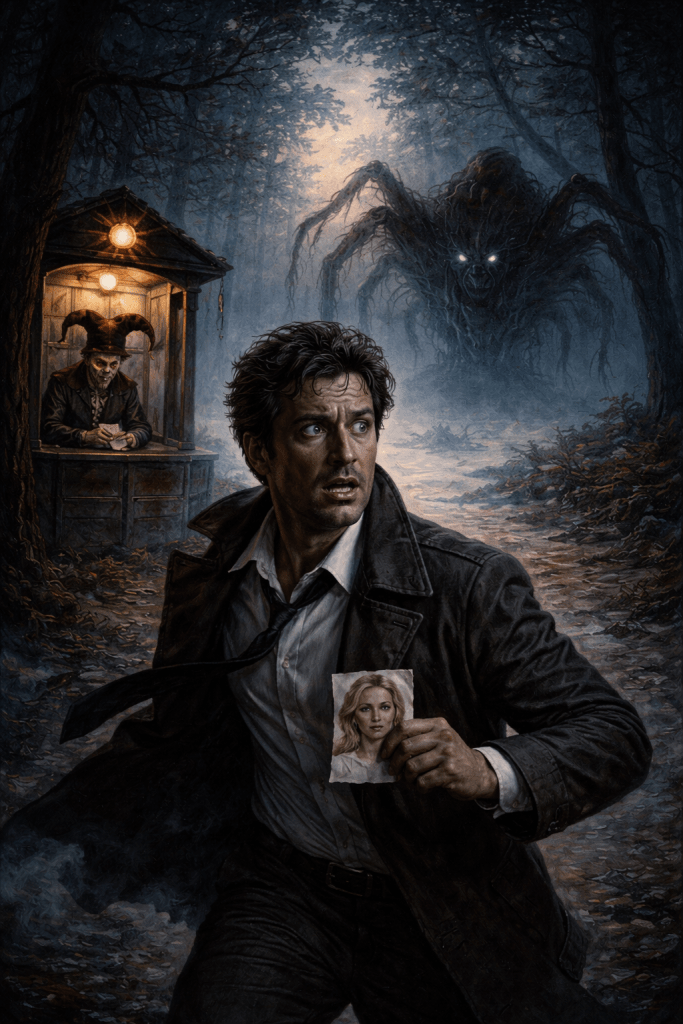
A torch flickered faintly in the distance. Humidity had quieted the flame in the brazier, so that it hissed, a maddening red. It stood upon a small brick edifice, painted white: a booth. The toll attendant wore a jester’s hat.
“Lui qui rira bien rira dernier. You got that?”
I shook my head.
“It’s just a joke,” said the attendant. “You’re thick aren’t you?”
“I suppose.”
“You’ve also got wyvern troubles.”
“Excuse me?”
“Wyvern. Those draconic creatures with two legs. Emblem of Wessex. Whore of Babylon.”
Then, I understood.
“Yes, I have had—excuse me—how do you say?
“Wy-vern.”
“Yes, that kind of trouble. How did you know, and do you know which way to—”
“Civilization? The world? That’d be through this booth here. What if I told you, that at the Edge of the World there is a Mad Jester, who laughs at the sheer futility of everything? He cackles at the pursuit of nothingness, the vast chasm of meaning that is lost to meaninglessness, et cetera. Death especially, that’s a hoot.”
“And what is the toll?”
“Get him to stop laughing.” said the Jester, through exasperated breaths of laughter.
I heard the creature treading the gravel, through the mist. Then, I saw it: a hideous ebony serpent—the hide of the woman still adhered to its tail. I was astounded at the breadth of its wings: great black parasols that loomed over the country road. And then with sudden clarity, its form now in full view, it glared at me, and me at it. Its eyes rolled over white, as saliva frothed at its muzzle. Then, it charged.
The Jester laughed, of course.
I pressed a picture of my wife, up against the pane.
“Ce un belle femme. She’s beautiful, you know, ” he said.
I nodded vigorously, “Yes, she is.” He chuckled, but gazed longingly at the photograph.
“Are you going to let me pass?”
“Yes, yes. That’ll certainly do.” said he, and The Jester stopped cackling.
*
He printed my ticket, and slid it to me, slowly.
Regrettably, I handed him the picture.
The boom barrier inched upwards, like the second hand of a clock. My heart beat in tandem, and as it rose so it wiped the fog away, like a squeegee. Through the airy medium, the action revealed a vista and I saw the World, from the Edge of the World.
I saw the skyline of New York City, the mundane municipalities of Annapolis, the dunes of Gaza, and the slithering bend of the Seine. The waters of the Atlantic trickled at sunset over the rim of the horizon. All of it, a sheen flat as glass.
And then, I jumped into the murk of it all, narrowly missing a bite to the rear. I bounded into this world, immaterial.
 The Nebuchadnezzar magazine
Leave a comment