The Nebuchadnezzar magazine

A quarterly e-zine. Music. Health. Wellbeing

  • Facing Grief: Mitigating Violence with Art

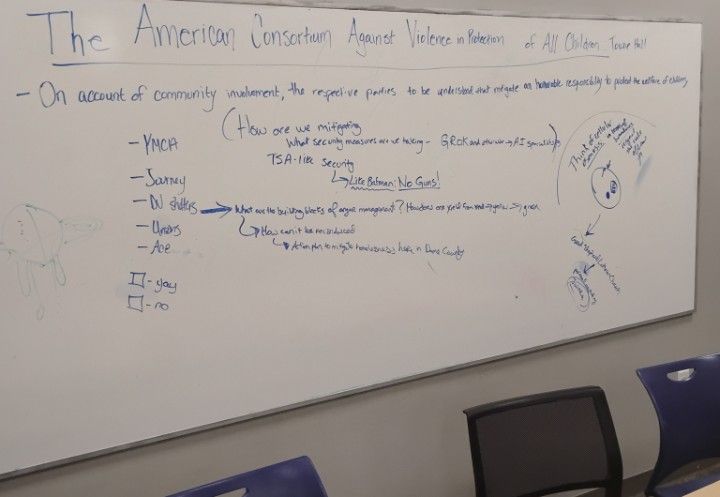
    The American Consortium against gun violence on account of all Children. A response to the NRA meeting held on November 14-16, 2026. Forwarded by the initiative of Good Shepherd Lutheran church. No Child left behind.

    On Mediating Violence with Art

    Copyright 2025. The Nebuchadnezzar Publishing House.

    The following is an outline of a speech to be delivered at Good Shepherd Lutheran Church, in part of Holy Cow (meals on wheels their initiative to feed the homeless), by Eric-Anderson Momou, an alumnus of Madison College, and UW – Milwaukee. The degree he holds is in English: Literature – Cultural Theory. And an Associates of science from Madison College.

    Furthermore, the following is to be presented extemporaneously on account of the audience if the original speaker is unable to deliver it.

    A speech by E.K. Anderson (Eric-Anderson Momou)

    Hello everyone,

    I come to you today not as a politician, not even as a neighbor, but as a friend.

    And I am concerned on your behalf in lieu of the stream of recent events.

    I am concerned because of the regrettable deaths of both Irina Zeretska, and Charlie Kirk; that have been the subject of headlines for the past week. Their lives have been amongst the most paramount of circumstances that have occurred in our world today.

    (Pause for reflection). 

    Right now America is in a state of grief. The stages of grief as we understand them are:

    1. Denial 2. Anger 3. Bargaining 4. Depression and 5. Acceptance

    One thing, I have learned about the Stages of Grief, with death is that none of these Stages can be skipped. And oftentimes, they overlap into one another. until we accept it.

    (To which Kirk’s wife’s X Tweet – “Go to church.”) Really did hit home.

    I’m starting to realize that this is the only way for me to heal.

    I go to Good Shepherd. It is an LGBTQ safe church. And I, in fact, shed tears upon attending it for the first time.

    One thing, I have realized is that it is not about white or black at this moment in time. It about those who believe in Making America Greater than she is, and has been.

    We can side with racism: that being the collective opinion that every person of a certain condition, creed, or lineage is bad or we can begin to learn that or which we can do the opposite.

    What MLK, talked about with love as the greatest clearance.

    Instead of destruction, I ultimately believe in creation. Instead of defenestration, or destruction of public property, I believe in processing anger in a healthy way.  Taking anger into account, Now, creation takes a lot to begin.

    Sitting down at a table, and taking pen to paper. Taking a paintbrush, and painting on an aisle.

    While I live in a predominantly Democratic State, I am aware that I lean idealogically on the  right.

    To James Telarico, it is in fact about Top and down.

    Violence, we have seen, has been a rampant issue. Regardless of what implementation is used, it seems that it crops up at points most inopertune, and most incovalent…

    In our world, it appears that living in the United States is difficult to come to terms with what we may feel, and why we may feel a certain way.

    Despite these circumstances, what we see is well founded.

    We may feel uncomfortable. We may feel an uncanny sense of disregard for the general populace, but the truth of it is that we must remain calm.

    Lest we mournst, we must must amongst those who those who mourn.

    I must though must not mourn amongst the gnashing and groaning.

    It is upon this cliff, or some may say a mountain, that we must submit our greatest of challenges.

    We must see the summit, that arid cliff on which mourn and not cast ourselves down from it.

    Such an instance may cause one to pause, and reflect. To posit a self-reflect ion unto that which is necessary. And to examine the circumstances unto which is under so as not to go under such diress.

    We may mourn upon the circumstances under which fate is dealt, or  instances of violence occurring in our world today. It has caused me self introspection.

    It has caused me to personally reflect upon the instances of violence that we have been a part of in this nation. The lack of personal culpability, or the admittance of error forthwith and there-in is of personal note to me.

    To be self accountable is the substrate of progress. To say you were in the wrong

    I do not concur with Fox news presenter Brian Kilmeade, who retorted to kill the homeless, and mentally ill.

    I do not agree with popular influencer, Matt Walsh, who says we want their heads on pikes.

    These are the current words of socio-political commentators. Words we know have the ability to heal or to harm.

    It is on this evening, that in regards to the stream of recent events, and our own self-instilled faith that we have congregated here together today. 

    It has come to my attention, I, Eric Momou  pronounced phonetically  (like “air” + “ick”) last name Momou → moh-MOO) (first syllable like “mo” in “moment,” second like “moo” the sound a cow makes). It is ironic that my last name sounds like a cow. And my bank card (show it) has the very markations present of a dairy cow.

    Amongst you, at Good Shepherd Church (meals on wheels in Madison, Wisconsin) this simple revelation may not be shocking. It may seem of happenstance that these coincidences have occurred to me.

    But I beg to differ.

    I, a citizen of the United States, as well as an African, now so dubbed in identity as an African-American man who believes and who lives in Wisconsin is also proactive as to this very notion.

    Having noted that metaphor, I also note the state of affairs in which I live in. My significant other, brought me over here from the MeadowBridge library the other day, across the street.

    We are not a conventional couple. She is white, and I am black. The dichotomy by which this exists is by no means less than apparent, nor is it a simplistic issue, as I posit in the minds of many.

    We know this to be historical, true. She is from the South, and I am from the North.

    Anyway.

    There was food here, which I should reprimand myself for indulging in, I’m on a diet, and I was struck by the and upon making a public declaration on social media in which I said man must not eat on bread alone, in response to the rising cost of food prices, I was hated by many.

    I said this in response to the current economic situation by which our current President has dangled as a carrot upon a stick in the view of many. Lest we agree with his degree of mercy, we shall not have food.

    But I beg to differ. There is mercy of another kind.

    How many have struggled to get by, and provide food for their children? How many of us have worked tirelessly only to have food prices go up exponentially?

    The answer is too many. Too have been slaughtered on account of guns. Now we enter the conversation on a Biblical front.

    While this is the truth, I choose to speak out, and while being hated for this truth there is still much to be revealed.

    A life is a life. It doesn’t matter if it hails from Eastern European origins, black, or white, or Hispanic, or Israeli or Palestinian.

    What I attest to is that _.

    In 2024, I was amazed by the response of the California fires by way of the aid that came from prison felons. They assisted in calming the spread of the fires.

    Because I was told that I could only speak in one way, or think in one way I was sequestered into a mental coral, a prison by which I knew I was shackled. Upon understanding my bars of incarceration, I sought a freedom of mind from group think, and subsequently to set others free.

    I note that we stand on the shoulders of giants.

    The voices of men, and the voices of women have been silenced for far too long. That is why I will be working with the Black men Coalition in Dane county, The center for Black Excellence and Culture, Journey Mental health services, the Cultural Network, Immigration, a public defenders, and Law enforcement in mitigating violence.

    I will address this issue with poise, with amnesty amongst our borders and Immigration.

    Let it be known that this consortium will be working with Domestic Violence shelters, most notably social services as well to end these occurrences.

    I posit open discussion on the topic of mental health, a new consortium amongst people of many topics and many walks of life, to come together and evaluate laws in respect to gun and criminality occurring here in the United States.

    If we are to Make America great, we cannot abuse civil liberties. No, we must look within at the choices we make, and how they affect others.

    And Wisconsin, being the heartland of our nation, we must self-reflect, and pause before anger. Meditate, and look at ourselves in the Third person. No more green to red.

    Yield on account of our emotions, and practice peace in what we do.

    Such will be a Renaissance.

    Therefore, I will be working hand in hand with our artists.

    We must create. That is why I will be working with artists, and builders, our construction workers no matter their background in discovering their personal excellence.

    Our mayor Satya Road Conway, has posited a difficult job. And though that mantra of convergent authority is difficult, I do suppose we conduce our bus system towards notable businesses for the transportation aorta of Madison to conduce to Chicago intravenously by way of train.

    I am for electric vehicles.

    No matter what culture we belong to, we recognize this as an international, and intersectional conversation.

    EDIT FOR TACT (Remember not everybody believes, as you do Eric): Upon a difficult turning point in my life, where I betrayed those who should been most dear to me, I was at a moral crossroads.

    I had an encounter, of some would say the Third kind. This encounter I do not posit as a normal encounter as one would have physically with another human being. And I do recognize, that this experience is not for all.

    I remember walking from the library. Oddly enough, I started to hear whispers in my mind. There were many voices by which I could hear. And for a moment I felt as if the artist or writers bought of insanity had ensued.

    At the nexus of mental health, I will say that hearing voices is honestly a strange thing. The mental disorder schizophrenia is an example of this.

    While I have not been sequestered into the diagnosis of said condition, I do believe that we are beyond due for a discussion of mental health in this country.

    Mental health, as a phenomena is in part matriculated in different categories in the DSM 5, a strict medical guideline by which medical professionals use for the diagnostic procedure of their patients.

    Psychiatric illnesses, are understood as pathologies. They are diagnosed via symptoms, and with extensive medical training they are understood as diseases.

    In the psychological, and psychiatric literature, the medical community surmises that the hearing of auditory hallucinations is indicative of a condition unbeknownst to many who do not have it. Such, is deemed mental illness. More so akin to pathologies such as schizophrenia, bipolar disorder, or borderline.

    At the cross-roads of such we wonder where our lies. In the end, we have the freewill to make that decision. But I choose to use mine for the betterment of my community.

    There was much destruction during the George Floyd riots, and try as I did to mitigate such violence, the fury was evident.

    It was upon visiting the library that I was hit with a splitting headache.

    However at this intersection I noticed a plethora of voices, and in such delirium the only sanctuary I sought out, was this very building. These voices were Legion – as one would describe a telephone patch with many voices speaking apart from each other.

    I do not wish to get into the details of what I experienced, but I did note the voices were spoken in different languages, different tongues.

    Good Shepherd Lutheran Church. For many who have been raised in church, the topic of homosexuality has been deemed an enumeration of Sodomy. They have been relegated as lost as was the account of Lot before destruction came upon them in the very city of Sodom and Gomorrah, by which our current ontology of the word hails.

    Oddly enough, I sought solace from these very voices, and the destitution of my state came here.

    However, the voice that I heard upon reaching these very church doors was silenced. My hand touched the glass.

    And upon walking to the bus stop, there came upon me a voice that silenced all other voices in my head. That voice, as outlandish as it sounds, was the voice of my Saviour.

    I have relayed that experience like a VCR in my head for some time. On rewind, it seems incomprehensible, even ridiculous but it stuck. And since that experience the voices have ceased.

    I walked to the bus stop in the rain.

    I touched the stake of the bus stop to the H and I knew there in the rain. As a black man living in the state of Wisconsin, I knelt at that bus stop. It was an odd experience and felt foolish, but something impelled me.

    Being raised a Jehovah’s witness I prayed to the Yahwehnistic God of my upbringing. But as I closed my eyes, I saw two clouds. The greater one, a cumulonimbus spoke with a voice resounding with thunder.

    I petitioned for it, as I recognized it, to be the voice of the God of my nascent origins.

    That voice said, “Pray to Jesus, if you are to return.” For Jehovah’s Witnesses, or those of any Abrahamic religion praying to a man is seen as blasphemy. How could a man suppose the same authority as one would God?

    I struggled with that notion for a bit, and after the voices became more intense, I had no choice but to yield to it. That Law, I felt was engrained in my nervous system, and as a result of my humility I chose to kneel. That humility I call “a glimmer,’ by which my very nerves were healed. I felt sense of recalibration, perhaps more can be researched in regards to this phenomenon in regards the community of neurology.

    I remember the vision, from that smaller cloud eminated a voice. Soft and comforting akin to Matthew Brodericks adult Simba.

    It calmed the voices, and so I knelt.

    In the perifory of my vision, superimposed I saw three signs. One of a pill, another of a cigarette, and another of a condom.

    There was a checkmark after each of them.

    The voice said, you are to get rid of these three things if you are to talk to Yahweh.

    Then I remembered the scripture, Jesus spoke of when he said, no man comes to the Father except through me.

    I knew these words to be true.

    So then I was led to this church by way of my signifcant other. I a sinner.

    When my significant other walked across the street I followed her. The staff offering the tacos were kind. They were Mexican tacos, I remember from Holy Cow were amazing.

    We settled on the grass. We had no seats, but we listened to the indie pop band under the tent. Their music reminded me of Iggy Pop.

    A lady offered us chairs. Then, despite my discomfort, the sermon began.

    A female academic spoke her testament, and the pastor said a prayer.

    It was after the prayer, a disabled woman spilled cheese sauce from her feet. I asked Kirstin for a napkin, and wiped the cheese sauce off her feet.

    It was then that I learned that I was being called. The signs are something I see in my dreams. I see a celestial chessboard wrought of starry pawns.That is why I write ✍🏾 in the genre that I do. It is in fact vision being made manifest in the genre of Magical Realism akin to Isabel Allende, the writer of “The Alchemist” Paulo Coehlo, and Victor Borge’s “The Aleph.”

    (The genre I write in is classified as Magical Realism. The Latin-American authors noted above have been and continue to be my influences. It is how I express myself.)

    I now know that my personal ministry has shifted in a different way to help all races of men, all lives, and all people. God is not prejudicial.

    This ministry is far more than we would have understood, I believe. Dwight Eisenhower, the 34th American President, whose mother was coincidentally a Jehovah’s Witness, spoke upon these matters – in particular the love of liberty.

    Liberty as we understand it is freedom of thought, freedom of mind, and freedom of speech. With the silencing of men who have posited a different notion to group think, it seems as if our Democracy has exacted community justicd

    (That in our world today, I am of the opinion that there are some who have relegated cruel, and unusual means of exacting community justice.

    This community justice that is decried is a schism away from actual justice. This is why we see so many differing opinions in response to Charlie Kirk’s assassination. In fact from history, I see that those who were in fact assisinated, or attempts were made on their life were in fact the most honest of our number.

    -It is not the implementation of execution that kills a man, but rather the intention by which he is killed. The intention can therefore be used as an implement for the intended purpose. It is up to our freewill how that implement, can be used.

    What I see amongst social commentators like Matt Walsh and Charlie Kirk, is the undying proclamation that they have used for times immemorial. That it is lawful to kill.

    The truth is, that it in fact is.

    Under these pretenses:

    -A person has threatened your family.

    -A person has threatened, or posited injurious harm unto your person.

    However, the arbritors of said community justice has been relegated to the personal condemnation of the individual in power. In our day, this may be relegated means the Germanic man, who hailed from the Germanic tribes originating from Rome, by which they have had Celtic and Eastern European origins. These “wayward” tribes, anglicized after their perceived barbarism after the crusades, I posit have had a projection of self unto other tribes (othering). As colonialism continued in the 17th and 18th centuries, so did anglicization.

    This othering has been of the kind, by which we in the modern day may describe as racism. A sort of verisimilitude into the public Oversoul conscience that is stipulated on the Truth from the Lie, darkness from glory, light from shadow or black vs. white.

    Racism then, is the public opinion of a moral fall by which one member of a tribe dies. This collective consciousness may be falsely attributed to all members of their number.

    I have heard of the killing by a member of the LGBTQ+ community upon children in a very church in Minneapolis. I have heard of Irina Zeretska, and the assassination of Charlie Kirk.

    However, I do not believe that correlation does not equal causation:

    A child may kill another children, but do all children kill?

    Furthermore does a child who breaks the rules on a playground, such as throwing gravel at another child, not learn from their error. And even more so, do all children throw rocks? 🤔.

    Let he who does not sin cast the first stone.” A poignant statement.

    No. Such that, not all LGBTQ+ kill kids. Also not all Black people kill Ukrainians, or whites. But there are and have been very many whites who have killed blacks, and other minorities.

    Therein lies the lie of the substrate by which the enemy uses to condemn us, if we do not choose salvation.

    What then do we choose.

    The narrative therefore goes, if we as a Democracy have allowed faith in our African Americans, and they have killed a narrative of our democracy does that mean the epigraph of all African Americans? No.

    In fact, I do not believe that entire group of people must be villiainized, and brought down on account of a select fee who choose otherwise.

    Why then, must they be collectively all be mistreated on account of the action of one man, a tale of which we may know or not know to be true.

    We do not hold one children to the same moral arbitration as to all of their number. Or do we? These are questions we must ask ourselves as Americans.

    So then, to my point: we are all children on this playground until Recess is over. What happens after Recess is up to us, individually with freewill.

    For men such as Matt Walsh to say the following:

    “…I can’t even fully articulate it. It’s primal. We want scalps. We want heads on pikes.”

    This was why I wrote All, Us Children, because Jesus said, “Unless you become as these, you will never enter the Kingdom of heaven.”

    -Words as you well know, Matt Walsh, are incendiary. How little a flame it takes to set a woodland on fire. – I’ll let you figure out what passage of the book that comes from.

    His words are holding true unto this very day. The Bible also says in regards to the very Jews who killed him that they do not believe about Jesus, even until this day. Ironically very many Jews do not have a channel to believe in, because of pride, I do believe, and lest they have a mediator by which they have empathized with slavery their Rabbinic belief still exists.

    If supposed Christians continue to hate, that therefore continues their version of “racism,” so posited Anti-semitism.

    Now then, if that person is no longer your flesh and blood, you no longer have a legal right to kill them or even protect them.

    You can extend that, that is true, but what I see in your tribe is a lack of concern for your fellow man. Hopefully your neighbor disagrees.

    Oddly enough through my escapades, I believe I have encountered the KKK. Harassed by them in fact.

    I took up work at a hardware store. A man without an arm, with a prosthesis, labelled in an American flag met me.

    He was looking for galvanized screws, but he didn’t know which size. I asked for what intended purpose? He said: for a motorcycle.

    Interesting, I thought.

    I also need a black pipe he said.

    Black? I thought, that’s interesting. That word, itself is a dillineating trigger, of which I suppose is a demarcation between good and evil.

    Okay, I said.

    Ya… He said, something for the hose line.

    “For the hose line…” I said.

    “Ya,” I noted he sounded Southern. His hair was long, like a Hell’s Angel. Graying, and fraying.

    Anything can be used as a weapon. A fist, a nail, a ring.

    “What size,” I said.

    “Three fourths, probably galvanized.” I noted his demure expression, an uncanny grin on his face.

    I showed him where to find them, and he said, “Hmmm, not this kind. Nevermind. I’ll be back.”

    With that he left the hardware store. He has since come back.

    Either way, I figure, I caught him in the act. Gang stalking, while not recognized in the court of law, and is enumerated as a conspiracy theory, has a basis to those who choose to speak upon their experiences.

    Either way:

    -Cain killed Abel with a stone. It wasn’t a gun, mind you. The intention was to kill, not desecrate, or vilify. The intention was to kill.

    The stone, therefore is an interesting symbol. So are pikes and scalping which are known as torture methods. They are another method by which to kill ones enemy.

    Stoning still occurs in very many parts of the world. And I do not need to tell you which places by which these may routinely occur. The people that do these things are relegated under a moral code, and a moral hierarchy institutionalized for generations.

    A bullet is made of steel, a modern day equivalent to a  stone or pebble as would David would have used with Goliath.

    To quote Malcolm Gladwell from his book, “David and Goliath,” a projectile is used as a modern day equivalent of a stone, circumvented with modern day propulsion, to reach an intended target at the hands of technology.

    Beware of the interplay which technology can be used.

    That “target,” if one is skillful, hits center mass – or some in the police profession know as the area in which kills immediately.

    Words are incendiary as well. They too can be used as projectiles.

    The declarative statements by which many . White men who continue to be for MAGA, on the Right continues to reveal the hatred for all who are not like them.

    In the end though, I choose to love.

    We cannot bar our hearts or our people from doing what is right.

    Acts 2:17

    “In the last days,’ God says,

    ‘I will pour out my Spirit upon all people.

    Your sons and daughters will prophesy.

    Your young men will see visions,

    and your old men will dream dreams.”

    Woe to you scribes and Pharisees who bar the way to heaven.

    Thank you.

    Edit 1

    Copyright 2025, The Nebuchadnezzar magazine.
  • THE MIRACLE MACHINE

    by E.K. Anderson

    The man donned uncannily neat attire and bore the likeness of the Bourgeois. He wore a cravat and ornate cuffs, reminiscent of seventeenth century Parisian bankers and businessmen. Trimmed and flush with his jaw line was a graying beard, with patches of black like ground pepper. Pants perfectly tailored about his legs, his slim countenance implied one of guile, authoritative and classy measures. In his left hand was a pocket watch, one in which he concerned himself with constantly, as if by some way his gaze could hinder time. In his other he carried a half-full glass of moonshine He was a rebellious man by nature, free of the shackles of faux pas, unspoken nuances and taboos of society.

    “Punctuality is a virtue Dr. Mayson,” He looked again at the pocket watch, facial expression as crude as a stone etching, “As it seems that you are the only interviewee, I’m willing to overlook the minute fact of your tardiness. I recommend an atomic clock. They’re the best,” said Arthur Morgan.

    In the doorway, surgeon Richard Mayson Ph.D, stood somewhat confounded and uneasy, believing that he had in all truth reached the premises a minute early. In his hand was a jumbled collection of papers: his polished medical resume, the papers he had written for Cambridge academia and any spare credentials he could manage to gather about his second-story London studio. Clumping them together in his left prosthetic, he shook hands with the man.

    “I’m honored,” he said in a stunted manner, “I apologize. I’ll take up that recommendation.” He lied, knowing quite well he would not.

    Through his bifocals Mr. Morgan peered at him hauntingly, the moonlight refracting in the lenses, “Come in.”

    Richard stepped over the threshold. Already like some irritant or foreign matter, he began to reject his notions that the man was in any way sane. The mansion, had little in it, which surprised him. A myriad of corridors, ran perpendicular to each other; both upstairs and downstairs, leading into grey and dusty rooms. Tapestries both as large as his head and the size of a man lined the walls. Green velvet draperies hung lankly from the Venetian windows. The room spacious he felt small, the rotunda wavering above him like a sky about to fall. He saw what looked like a replica of Creation of Adam, the fresco from the Sisteen Chapel (which he had always wished to see in person). A brick hearth, burned steadily, hardly crackling.

    All about, in tandem, he heard the tintinnabulation of clocks like miniature glockenspiels. It irritated him, a throbbing nuisance at the back of his head.

    “I’m a bit of an antiquary. My associates regard my house as noisy and mad labyrinth, unusual really. Yet I enjoy the ruckus. Hearing the seconds, the milliseconds of the day as they pass tend to inspire me. Do you find it quaint Dr. Mayson?”  

    “Fine. It reminds me of Mister Gepetto,” he said mistrustfully, “Pinnochio.”

    Mr. Morgan clicked his tongue and raised his brow, “Fair enough. Moonshine or Scotch?”

    “Scotch,” He preferred no alcohol but felt obliged to be courteous, “Just a little though.”

    They sat in the middle of the rotunda, adjacent to the stairwell and juxtapose to a small table with an unusual colorful fish centerpiece. The room still, tension affixed in a single state like dry ice.

    “Chinese fighting fish are my favorite,” said Mr. Morgan, “They are not a dog or feline, but they are ever enduring, quite resilient to change—the aquatic equivalent of a cockroach.”

    “Don’t they fight? I mean if they’re put together?”

    “Yes. This one lasted longer than the others. Battle of the fittest.” In the aquarium, he now saw two fish, their bloated bodies inflated twice their normal size. They bobbed up and down, their eyes glazed over, dead.

    “You do this for sheer entertainment?”

    “Not for sport, my good doctor. Science.”

    It was then that he remembered the three indications of a sociopath in the discipline of Psychology: Bed-wetting, arson, and animal cruelty. So far the man had already gotten one.

    “Before we begin, I can assure you Mr. Mayson that what I do is completely legal. Pristine and free of swindling. A monetary interchange, for a service. There is nothing shady about that. No loopholes, no thrifty advances, just an equal exchange,” Mr. Morgan smiled.

    Richard Mayson did not like the sound of the man, his inflection had a conniving aura to it; he had the air of a mortician or a crafty door to door solicitor.

    “And the expense is?”

    “A penny will do.” The ‘service’ for a little loose change that might have easily tumbled out of his pocket unbeknownst to him was all he needed? Surely there was a twist.

    “Why so cheap?”

    Mr. Morgan took a sip of the liquor from his glass, sampled the moonshine and grinned politely. “I won’t be a financial burden to you Mr. Mayson. After all this is an interview.  A penny saved is a penny earned. It truly is a small price to pay. Yet on my behalf why not capitalize?”

    Richard felt his tailored pockets; the only thing that came up was nothing more than the cold copper coin, the last remnant of the suit he had bought. Reluctantly he paid the man the remaining sum.

    “One thing I must tell you is that there is a contract, just as with any job. Here,” said the employer, handing him a thick wad of paper,s the size of a manuscript, “a pen to sign.” He ruffled through the rest of _.

    He took it reluctantly.

    He could have read the minuscule writing; he could have mentally underlined and scanned all areas, all unclear ambiguous statements—the impurities.

    But he didn’t.

    He signed his name in careful orthography in the blank. “What’s the—”

    “Date? The ides of March. The fifteenth to be exact,” the man smiled taking the pen and stuffing it in his suit coat pocket, “the day corpses lie in the streets.”

    “Can you tell me anymore of the position?” said Richard tentatively.

    “Unfortunately that cannot be done. Not yet anyway. All I have been instructed to tell you is that you are about to enter a machine.  The subject of which can be described as a test.  Of what sort? I cannot say.” He poured himself some more moonshine from the flask, deliberately letting several drops fall into the miniature aquarium. Immediately, the fish with tattered fins breathed the alcohol through its gills. The result was a feral creature, attacking its own reflection.

    “Where exactly is this test?” Richard said, choosing to ignore the fish.

    “This way.”

    Richard carried his scotch with him. The man led him down the ivory stairwell, into a far more grandiose room than he had seen, thus far. It possessed the sterility of a hospital ER, yet spanned farther back than a quarter section of a football field. Oddments, Petri dishes, chemical tubes, DNA jelly, Bunsen burners, neon containers of solute. But what took his attention away was not the sheer quantity of equipment but a generator unit, stashed in the center as the main cornerstone of the laboratory. He still heard the clocks, the sounds followed him wherever they went.

    “I believe this has been the reason for your intrigue, Mr. Morgan and inversely my life’s work in the making. It can be perfected but the premise and overall objective works.” They walked closer; the machine looked very much like a titanium box with a series of hoses and cogs about its central interface. A spring-like contraption, antennae-like sat atop it.

    “Tesla coil?”

    “Yes. It’s far more efficient. Eighty-five percent electrical transfer. I prefer to use that as my energy source.”

    “Ah,”said Richard sounding amused, “ May I now ask what it is?”

    “It’s a machine, meant to manifest and trigger your sentient capabilities more or less. An enhancement allowing you to delve into the greater recesses and conduits of logic not normally visited, since only 10 percent of the brain’s thinking processes are accessible under normal conditions.” He smiled through his beard in a gregarious manner, “Simply put, a dream machine.”

    “A machine for catching dreams? You mean to tell me that you can take an intangible thought and make it concrete enough for another to witness?”

    “Not necessarily. For discerning them. There is no eyewitness but the dreamer. However given a sedative, such as what was put in your share of moonshine, one can relay the visuals far easier after the point of visual stimulation.”

    “Visual stimulation?” Dr. Mayson smirked. He was beginning to laugh impulsively, whether it was the liquor or the outlandish information that was being force fed to him like an infant he did not know, “And how exactly is that accomplished?”

    “Electrodes. Implanted in the brain’s pleasure and visual receptors. Implants– should I say– appear to be your area of expertise.”

    “Surgery. Yes,” Richard said astutely, “But I’m in no way about to undergo any procedure that would strip any person of their freewill. Altering another’s faculties for a laboratory significance is beyond me.”

    “You have already accepted the job offer Mr. Mayson, as well as volunteered to be our first guinea pig.” Mr. Morgan unfurled the contract from his pocket. In minuscule writing, barely enough for him to see, Dr. Mayson read the words… and his signature.

    “You will profit much. Half the shares.”

    “Potential shares,” began Richard. He was skeptical but wished to inquire more. “And how will this make a profit?”

    “Economists my dear sir, economists. The world’s businesses and corporations. Imagine if every fluctuation in the stock market could be foreseen, every variable accounted for—predestined all with a single prophetic dream. Clairvoyance achieved.”

    “But you said it was a dream machine,”said Richard, “How does prophecy relate to dreams?”

    “God bestowed man with dreams, Mr, Mayson. It is thus up to man to to decipher the cryptography of conceptualization. It has often been said that there exist three dimensions. Some have alluded to a fourth such as time, but I propose a fifth which is metaphysical.”

    “Which is?”

    The man smiled and swelled his chest, clearing his throat with a slight smile.

    “Thought. Or more so consciousness.” 

    “But,” began Richard, “Thought isn’t concrete. How could that which is not physically existential be a–”

    “Dimension? That is where you are gravely wrong,” said Mr. Morgan who had taken the liberty of reclining on a laboratory bench, “Regard it as a deviant of Time which is immaterial: that which stays afixed, but in theory may well be manipulated to one’s bidding, can be warped. Such is the same principle with thought. Unseen, it exists on its own separate plane. In part its origin is physical: existing in a precognitive form, manifest in every neuron impulse, every synapse overload, every rudimentary cell process and in turn electron revolution. The question, and sense of better judgment, is what is the catalyst for thought? Where does it originate?”

    Richard stood smugly, arms crossed. He could not question whether the man was at his wit’s end or an intellectual heavyweight. In his brain the two portions of rationale and blind faith warred, amplifying the nausea of the drug that had been administered to him through the alcoholic beverage. How near or far from the truth the idea actually was, was frivolous. He needed an ibuprofen.

    “I don’t know.” Simple and precise. He found the man’s subtle aggression irksome. “I suppose I’ll find out won’t I?”

    “Perhaps. But only with your expertise. We are both men of faculty, do-gooders are we not? Let us reach a consensus. I will grant you sixty–no–seventy percent of the shares. Surely you must acquiesce to that.”

    Richard stood dumbfounded. He felt numb. The salary would exceed his surgeon compensation, allow him to pay off any remaining medical and residency loans.

    But he was still taking a gambit.

    “There may be certain physical repercussions,” said Morgan. He had finished his flask, and sipped distastefully at the remaining melting ice, “Of which I won’t sugar coat.”

    “As is with anything there is always a catch. If so I want to hear them before–”

    “You set foot in the machine? That can be arranged. Psychosis is one. Also an effect similar to a hallucinogen as the residual drug is still in the system. Nausea and vomiting as symptoms. That sort of thing. I won’t bore you with the pharmaceutical implications.”

    The prospect of a sanitarium seemed dismal to him. He couldn’t throw away his career for this. Nor could he toss the potential monetary gains from out his head. This was nonsense. “What’s the probability?” he said impatiently.

    “Less than 1 percent.” From his suitcoat pocket was a silver flask, shining bright against the lab lights, Richard saw the distorted refraction of his face. This, Morgan poured in his glass.

    “Toast,” Morgan said.

    “Toast.” They clinked their glasses, the sound pealing—resonating throughout the room.

    He stepped in the box, underneath the Tesla coil.

    “I wish you Godspeed on the Primrose Path, Mr. Mayson. ” said Morgan. He took the penny from his suitcoat and raised it up in the light. “E pluribus unum,” he read on the inscription, “One out of many.”

    The door closed, the tumblers clicked, the darkness ensued. Richard did not know for how long he had been in the machine. Minutes? Perhaps hours. He shuffled sheepishly in utter darkness; he paced uneasily—and fell. He expected to hit his head on the far wall. He expected to have been hurt and bruised, bashing his head in.

    But he didn’t.

    The first thing he ascertained, or rather perceived was that the box was far more spacious than he had deemed. He had fallen—yes—that was true, but he landed, not on the rusted iron floor of the machine. In fact Richard wasn’t sure he had landed at all…

    By some unseen force, it occurred to him that he was suspending; he felt wind whip his hair—tumbling into some intangible, nebulous void. He felt heavier, as if gravity had increased 3 fold. His head ached.

    Light.

    He saw that now. A pinprick below the canvas of black beneath him. Yet it increased exponentially…perhaps he was accelerating faster than he had deduced.

    The pinprick grew larger, like a nearing halo. A portal. And as quickly as he had fallen, he had stopped. Gravity had neutralized had it not? Now he… floated.

    In haste he entered the aura, almost numbingly at first. But something even more had surprised him. He could feel his right hand. He looked down. The prosthetic was gone. In place of it, was a hand—very much like his left—with feeling. He pinched it and winced.

    The universe had employed a nasty trump. This was unwarranted, unjustified nothing short of miraculous. It’s just a dream. Only a dream. But a wonderful dream it was.

    He floated further. From his vantage point, he saw clouds. Towering nimbus, with mountainous facades. He saw the flash of lightning and felt the resonance of thunder deep within his chest. He felt rain dappling his cheeks—flecks of snow too. Yet the light still bathed him. He felt like basking in it, reclining into an everlasting slumber.

  • Are you patriotic? What does being patriotic mean to you?

    I feel that I stray away from politics these days. Being “patriotic” is really a misnomer for allowing unseen, amoral things. You flow better that way. I believe in the practicality of Democracy more and more each day. But I do not align with either party. This upholds “professionalism.” But I do not approve of adverse, undisclosed, or untruthful action meant to limit those who are willing to work.

    I consider myself more apolitical.

  • Henry David Thoreau’s essay, “On Civil Disobedience,” holds true today.

    “Disobedience is the true foundation of liberty. The obedient must be slaves.” – Henry David Thoreau.

    “What I have to do is to see, at any rate, that I do not lend myself to the wrong which I condemn.” – Henry David Thoreau.

    There are times when a leader has gone too far, and projects on to others. Trump has done this. He has gone too far.

    Considering the recent stream of events, the callous nature of his public outrage and the derivate nature by which Trump’s post has garnered his network of supporters has further split the MAGA crowd from those who believe in human decency.

    We are experiencing a moralistic split.

    What then do we do in times of unrest?

    It is plausible that we make take the path of our predecessors. It is plausible that we start from where the Civil riots began.

    But it is more important to remember history. It is more important to recognize that we as human beings are the free agents of our marked free will. Violence is not the answer. It never is, and I could have used choice words I should not have, but I did speak out and say it wasn’t right. We as human beings have the ability to take a step back, pause, and reflect at the outcomes of our circumstances, and that we have a choice to conduce how change will occur.

    Accountability it seems for the President is quite difficult. It takes one to know one who must be accountable. It also takes one to know that accountability is the only way forward, especially for forgiveness to occur for others and oneself.

    Glossing over an error, does little address the issue. In fact it compounds it by several factors, and it requires an acknowledgement of the thought patterns that brought you to where you are in the first place. I have come to understand that truth distances us from the person we once were. It embodies wisdom officially, as it is practiced on a daily basis.

    It’s a challenge, but it is a challenge worth undertaking, because in that process (and this is new to me), you discover more of who you are.

    There are times when balance is needed. Stoicism, I suppose — not in the sense of avoiding the emotion, but in acknowledging erroneous behavior.

    People are not vessels of responsibility, or reproach. If an electronic system such as a circuit is malfunctioning, factors could be considered such as the resistors, or motherboards that are contributing to the issue. At certain points the person in question may be blamed for its construction, but not from natural wear and tear of the system.

    Such is the same case.

    You don’t resolve something like this with more violence. You resolve his rebuttal with personal reflection, stoicism and art. Through the process of creation as a part from his fake A.I. video one creates realism.You learn to satiate your anger, and let it not cloud your judgement.

    We are born for times such as these.

  • Describe your most ideal day from beginning to end.

    Day. End.

  • E.K. Anderson

    While the name Phyllis Wheatley may not resonate with many in the 21st century, her cultural  legacy pervades throughout many literary influences in our time. Phyllis was born in Senegal/ Gambia in the year 1753. Kidnapped at the age of 8 and placed on a slave ship in 1761 she was brought to Boston, Massachusetts and sold as a personal servant to John Wheatley as a personal servant to his wife. It was in this interlude of destitution that Wheatley began her more adamantine aims: that of being renowned as amongst the first female African poets and writers of her generation. 

    Under the tutelage of the Wheatleys, her studies of both Latin and Greek excelled, thus being notable influences in her works in 19th century America. Her most modest, and early works emulated the influences of both Homer, Virgil, Torrence, and Ovid — providing both the disparity and delineation to her contemporaries: Jupiter Hammon, another founder of African American literature with Christian sentiment, and Phillip Quaque . In his work An Address to Miss Wheatley, Hammond commends Wheatley for her religious beliefs, even though she was taken captive from her homeland — urging her to remain steadfast in her Christian sentiment.

    With her two children, Sussanna Wheatley therefore took her under her wing, and educated her accordingly encouraging her to read and write with particular care as to the classics. Thus, acquiring the surname of her master, she continued to write in earnest, propagating an immense body of work in conjunction to poetry and literary extrapolations. At age 13, she wrote her first published poem. In it, she documented a tale of two men who nearly drowned at sea, thus published in the Newport Mercury. Of note to her fame was her only body of prose and verse called Poems on Various Subjects, Religious and Moral which was published by Selina Hastings — the countess of Huntington, a Methodist religious leader in England (Hastings, 1). 

    With the aid of her contemporaries she became the first African American, and most notably the first African American woman to spearhead such antebellum rhetoric with the intertwined nature of spirituality and religion. As a founder she helped establish the disparity of the African American, the African, and the slave as an unjust affect to her cause – mirroring an unparalleled pathos to the cause of abolition, and Christian Pharisaic hypocrisy in relaying her the very conditional nature of her sentiment. 

    Taking sides wit George Washington amongst the trials and tribulations of the Revolutionary War, Wheatley may be ascribed as a truthful revelatory patriot, with a strong affectation civil, and moral precedent. She was subsequently invited by Washington himself in 1776 in the year of our Independence Day. 

    Continuing onward with a spur to her literary aim, Wheatley moved to London, where she met difficulty in her decline of health. Upon realizing such, she moved back to Boston, Massachusetts where she met John Peters, a free African American man. She birthed three children, all of whom died in infancy. 

    She died in her early 30’s in December 5, 1784, and remains as one of the most notable African female writers of her millenia, founding a sentiment of abolition intertwined with religious freedom that resonates with both writers, and readers of our day. Though procuring no heirs to her literary accolades as the first African American, and female poet of her generation to publish a body of work in American tribunals, her maternal fortitude in her pacifist allocations lives on in the aspirations of many who listened (paving the way for writers such as Octavia E. Butler, and Samuel R. Delaney), anthologized in the public consciousness of African American literature.

    *Passage from Jupiter Hammons address:

    “I pray the living God may be, 

     The shepherd of thy soul; 

    His tender mercies still are free, 

    His mysteries to unfold.”

    Works Cited

    Phillis Wheatley. Biography. Online. https://www.poetryfoundation.org/poets/phillis-wheatley. 2019.

    Letter from S. Huntingdon [Selina Hastings, Countess Huntingdon] to Susannah Wheatley, 13 May 1773. http://www.masshist.org/database/viewer.php?item_id=794&br=1. 13 May 1773

    Phillis Wheatley. https://www.biography.com/writer/phillis-wheatleyJuly 22.2019.

    An Address to Miss Wheatley. Online. https://www.poetryfoundation.org/poems/52292/an-address-to-miss-phillis-wheatley. 2019.

  • Daily writing prompt
    How do significant life events or the passage of time influence your perspective on life?

    Such is life. The case bestowed from the wanton few who believe it to be one of either polarity: a flippantly bemusing carnival, or a nihilistic abyss have little understanding of balance, scope, breadth, or spectrum of life. Stoicism, it is my personal belief, if it is not internalized from aloofness or nonchalance –for Man, becomes Chaos.

  • What are your favorite sports to watch and play?

    I enjoy extreme sports like the X-games. BMX, and skateboarding.

    The Olympics

  • A short story by E.K. Anderson

    “Put this on,” said the Salesman. He handed Demetria a halo-shaped visor. 

    With difficulty, she placed it over her pompadour, and head. Then, with a buzz, the visor turned on. 

    She rolled her wheelchair closer to the aquarium. 

    “I don’t see anything,” she said.

    “That’s because they glow in the infrared.”

    The Salesman clapped his hands, and the living room lights turned off.  Then the tinted, photochromic glass of the aquarium cleared.

    In the dark, Demetria watched the aquatic animals swim. They were of a simple sort: like archaic, large jellyfish with bulbous heads, two meters in diameter. Fleshy gills umbrellaed from under the mushroom crests, as hundreds of tentacles trailed beneath their bells.  Like a kaleidoscope, prismatic light reflected from off the creatures’ skin.

    “They’re called Methuselahs,” said the Salesman.“How’s the display?” 

    The Salesman put on his visor. 

    “They’re beautiful,” Demetria said, “Absolutely spectacular.”

    In the dark, the Salesman grinned. “Most of our clients say that.” 

    He knelt at the foot of the aquarium, and tapped the glass.

    Instinctively, one of the four Methuselah creatures directed several needle sharp tentacles in his direction. With a clang, the stingers struck the glass. 

    Demetria flinched. 

    “You’re safe. The plexiglass is seven inches thick.” The Salesman laughed. 

    He clapped twice, and the living room lights came back on. 

    With a sigh, Demetria relaxed in her wheelchair. She felt a bit of tension leave her frail body. 

    “How long until I’ll be able to walk again?”

    “That depends,” began the Salesman. “Most clients take a week tops.”

    Demetria shifted in her wheelchair.

    “And the procedure? How long will that take?”

    “An hour.” He walked over to the aquarium. 

    “Tomorrow, we will begin the procedure,” said the Salesman. “It is recommended to rest beforehand.” With a tip of his gray fedora hat, he left through the front door out of sight.

    Demetria was left alone.

    It was silent in her house, since the passing of her late husband. With the little eyesight she had, she looked at the hazy relics of her past life: the ottoman, the desks, the furnished cabinets. Everything reminded her of him.

    The aquarium tank which was bought by Methuselah Enterprises, stood in the middle of her living room — under the chandelier. She liked it that way: always glowing, colorful, and vivacious against the silver backdrop of the living room decor.

    She was feeling tired. A malaise: the sort of fatigue brought on by anticipation, and waiting. 

    She turned her attention back to the aquarium.The Methuselahs’ soft undulating tentacles in the stream of the aquarium felt lulling as they bobbed and dashed in a trance-like faction. 

    “Janus,” she said, “It is time for me to sleep.” 

    The House mec folded from the charge station in the living room wall, and with assistance she was led to her bed room. 

    Demetria slept well that night. She slept under the penumbric illusion that soon she would be safe from her delusion of old age; that soon she would be in a better place, as a result of the procedure she was to undergo tomorrow.

    *

    She was awoken by the doorbell, a small tintinning that registered on the intercom in her room.

    “Methuselah Enterprises,” said a voice on the Telex. 

    She could barely make out the face on the Telex screen, but she noticed the gray of the Salesman’s hat and suit, along with his black tie. 

    Hurriedly, she commanded the House mec to gather her clothing, and spray her with Eau de Parfum rose-colored water. 

    She met The Salesman in the living room. The Salesman carried a briefcase.

    “Perfect,” said the Salesman. “I thought I’d catch you a little past the hour. It is eleven past seven.” He grinned. “Shall we begin?”

    “Yes. Let’s begin.” 

    He put his visor on.

    The Salesman opened up his briefcase. Out from the briefcase came a strange oblong apparatus; one that, when unfolded, rolled on one wheel and balanced gyroscopically. It followed him like a dog.

    “Our procedure begins with the centrifuge machine.”

    He walked to the aquarium, and gazed at the glass through razor thin bifocals.

    “That’s odd,” said the Salesman. 

    “What?” asked Demetria. “What is it?” 

    The Salesman pointed to the aquarium.

    “You see this here?” His finger touched the glass. “These phosphorescent patterns.” 

    “Phosphorescent?” she asked, “What do you mean by phosphorescent?” Why did the Salesman have to speak in such cryptic language? thought Demetria. Couldn’t he speak plainly?

    He remarked at the perplexed expression on her face. 

    “The colors,” he said, “They’re  abnormal.”

    He clicked his tongue 

     “To be blunt,” he began, “They are irregular.” He paused. 

    “In what way?” Demetria asked.

    “Usually the colors – whatever they may be – remain the same. Here, though, we see a sort of strobe-like flashing, like an S.O.S. mechanism that the creature employs. This is an advent similar to hyperventilation in humans with an increase of cortisol. The creature employs this during moments of predation and camouflage. It does this normally during predation, but not usually before transdifferentiation.”

    He sighed. 

    “In other words, the creature is stressed.” 

    “It’s nothing to worry about,” he continued. “It will be taken care of. We shall keep an eye on it.”

    “What do you mean: transdifferentiation?”

    “They’re maturing, that’s what I mean. Changing from one form to another, by cellular repair. It’s what makes them practically immortal.”

    The Salesman put on his visors. He flipped on the light switch. Immediately, the aquarium glass darkened. 

    “On.” the Salesman said. A red colored eyelet turned on from the mech that came from his suitcase; this then turned to blue. With sudden speed, the mec rolled over to Demetria, who remained in her wheelchair. 

    From a door in the mech’s center came two tubes. The larger tube extended to the aquarium. With a serpentine protrusion, it entered through a vent hole. With much precision, it captured a Methuselah creature. A large needle punctured the bell, and subsequent flesh.

    Demetria squirmed.

    A green substance–most likely blood–seeped through the tube. 

    From the second, a smaller tube protruded a needle. It snaked towards Demetria like a cobra.

    “Not to worry. It is only taking a sample of your blood.”

     A blue light turned on from the end of the tube.

    “Roll up your sleeves,” said the Salesman. “The mec is searching for a viable vein.” 

    Demetria nodded in acquiescence.

    “Scanning,” said the mech. Demetria saw a green light and the network of veins on her arm. The veins and capillaries looked like branches, small tributaries. 

    The mec found her brachial artery, and with absolute precision, stuck.

    “Very nice,” grinned the Salesman. 

    Blood flowed from the tube to the center of the console, in the heart of the mech. 

    “Sample viable,” said the mech.

    “So begins our first dose,” said the Salesman. 

    He collected the sample.

    “This will be the return,”  said the Salesman. The green fluid from the aquarium of the Methuselah creature flowed through her veins. When the green serum reached her she tasted a metallic flavor in the back of her throat. Something like the faint taste of sea water. 

    She closed her eyes. She imagined water, a vast body of water– like the lake she had grown up by, near Townsend. She could see the lake in her mind’s eye: at summer time. Just faintly, she could feel the golden heat of the midsummer sun. 

    After an hour, the procedure was complete. The Salesman grinned. 

    “Well done.” He looked at his silver watch. “Perfect. Enough time for breakfast.” He cleared his throat. “How do you feel?”

    “I feel—” Demetria began, “I feel okay. Quite well in fact, but tired. Oh so, very tired.” She searched for the term. At ease. Spritely. Youthful. Awake.

    “Wonderful,” said the Salesman. He whistled and the Rover removed her IV. It sanitized itself, folded neatly with a pneumatic hiss, and returned back into his suitcase.

    “As always let us know of any new advancements,” the Salesman said. “Including any side effects.”

    He tilted his head.

    “May I have the visors back, Demetria?”

    Demetria shuttered. She liked observing the Methuselahs. 

    “How much are they?” Demetria said. 

    “One hundred denarii for every kilowatt hour.”

    “I’ll take it.” 

    She nodded her head, haphazardly in her wheelchair. As a widow, she had saved her ex-husband’s pension. He had left her with a modest sum: enough for the house, enough for the Methuselah startup hedge fund, and enough for her purchase.

    She missed late husband dearly. Just then, she redirected her thoughts, and came back to herself in the living room, and back to her body in the wheelchair.

    “Ah, yes. Of course!”

    Something about The Salesman, irked her. He was unlike her ex-husband. His demeanor: uncanny.

    Impatient, she tapped her foot on the floor, desiring to observe the creatures in solitude. She adjusted her buttocks in the seat uncomfortably. The Salesman, observed, subconsciously aware of her demeanor, seemed to catch on to her reluctance, and subtle apprehension.  

    “Ahem!” said the Salesman.

    “Feel free to notify us with any questions!” he said. “The new program for administration has already been downloaded to your House mec. It now knows the surgical functions it is to perform.”

    The Salesman turned, and pulled out a pamphlet from his chest pocket.

    “As for us at Methuselah Enterprises, here is a brief history of us, and our cause,” said the Salesman. “And as always feel free to donate to our charity—.”

    “I’m good,” Demetria said. 

    “Very well,” said the Salesman.

    He tipped his gray cap, and left. “I wish you well.” 

    She skimmed over the pamphlet for a clarification of her problem – but not for insight. Demetria read the history of the company. This is what she deduced:

    When the surveyor submarines found the Methuselahs at ten thousand feet below sea-level, the oceanographers had thought them a species of jellyfish. They’re infrared lighting, along with their translucent bodies had made them difficult to find, but after a submersible thermal expedition for underground volcanoes — they were found. After collecting several specimens, the marine biologists had discovered them: an unclassified species, apart from current taxonomy. The Methuselahs were another animal, classified as something else entirely.

    The first discovery was that the species could not be categorized under present nomenclature. No counterpart of their kind had yet been discovered, and as such needed a nomenclature of their own: Methuselah Faux – Cnidaria. The second discovery was that Methuselahs exhibited extraordinary curative properties from their secretions. 

    These secretions, integral in the process of “transdifferentiation,” or cellular reprogramming, as it was called — gave the Methuselah’s extended life. According to the scientific paperwork, they contained an abundance of “myelin and glial bodies.” When injected in humans, the panacea mended broken neural tissue. Such ailments as paralysis, and cognitive deficiencies could be cured –provided the subjects continued their purchase of new Methuselahs from the Organization of the Enterprise on a monthly basis.

    When the harvesters came after the polyp blooms, and the prospectors bought plots of subterranean land near the vents of the Marianas Trench, the corporations claimed the site under civil pretense, and booted out the biologists. 

    The secretion–sold under the same name as the animals–was auctioned to drug testing facilities, and after passing the necessary governmental statutes (of which there were many) sent pharmaceutical companies for mass distribution to ailing consumers.

    That was how the Methuselah Project was born. 

    She selected the digital Universal product code with her visor, and watched the convention talk. A holograph of a tall, wan man appeared on her visor, with a caption: Dr. Ralph Fineburge, Ph.D. CEO.

    He wore a black zipped cardigan, and black tie.

    “These animals…” began Ralph. “These pockets of life are the answer to our mortality. A fountain of life, discovered in an organism. They have been scouted out and appreciated for their beauty. Their prismatic horror is awe-inspiring. Methuselah is the answer. Welcome to the founding of Methuselah Enterprises!” 

    The crowd clapped and cheered.

    “We are currently in lieu of testing the Methuselah serum, and their bodies on human subjects. Trials begin next year.”

    The crowd of academics, and socialites applauded gainfully.

    Demetria turned off her visor. That was all she could take for today. She felt tired.

    Then her Telex phone buzzed, and she turned off the television. She answered the sales representative in gray. He greeted her with a cordial grin. 

    “Mrs. Conde,” said the rep, “We have just finished the first trial of the myelination process.” His voice boomed over her rec room speakers. 

    “That’s good to hear,” she said. 

    “You should be feeling the effects within a day’s time or so,” The Salesman said.

    “As for now,” he said, “We recommend that you get a good rest after your dose.”

    “You should be good for the next week until your next dose.”

    With a blink of her eye, she set the humidifier to a higher setting. In her wheelchair, she ambulated to her bedroom. 

    “Up,” she said, and the mechanical crane aided her into bed. 

    She rested well that evening. 

    This is what she dreamed.

    She was seated in an operating theatre. Down in the center, was an operating table covered in a dome of glass.

    Within the dome, she saw a large pale creature, human-like in form, laying flat on an operating table in the laboratory. She struggled to tell if the creature was breathing, but a frill of purplish gills flowed from its neck. These expanded and retracted.

    From her vantage point, the creature was large, nearly the size of two technicians. It lacked a nose, eyes and facial features. Surrounding its head, about its mouth, was a mane of tentacles. 

    With its body attached to a quantum server, the neurotranscriptionists set to work. They brought smaller relay machines forward, and began cataloguing its memories on a Telex, picosecond by picosecond. They’d regressed back on to earlier memories. Back into subterranean wilderness, back in the murk of the subterranean trench.

    Xosia, read the code upon the Telex. My name is Xosia. 

    The main laboratory technician walked over with a syringe. From the creature’s torso, he harvested green serum.

    “Polyps,” said the laboratory technician. “We must harvest them. An entire life tucked away in quantum drives.”

    “Check it under the microscope,” said the lead technician. “I need to know the side-effects of the serum.”

    “Of course,” said the less senior tech.

    The lead tech was speaking to the audience now, from inside the globe.

    This is what he said:

    “It is during this process of transdifferentiation, that we imbue the Cnidarian with an auto phagocyte, prompting its cells to emigrate away from its intended flowering body. The consequence is a depletion of cells on its hermaphroditic behalf, but the cause is just. These cells are highly myelinated, similar to our glial cells in our nervous system. What we harvest though are stem cells, which when the polyp replicates, is a panacea to end all ills. 

    He continued.

    “The side-effects of Methuselah, though, is a heightened tolerance for the drug. An exponential decay of glial bodies, which results in shorter youthful vigor. Hysteria, such as self-bifurcation, or personality incongruities have been reported in our sub-humanoid, sentient subjects. These subjects have then required a greater dose, after each sequential administration. The Methuselah Cnidarians, have been all but depleted. With similar nematocysts to the now extinct Portuguese Man o’ war, a single sting is fatal. 

    However as a defense, this is how they breed themselves. 

    “These larger alien hosts,” said the lead surgeon, “are their final metamorphosis.”

    She saw the face of the Senior tech. It was the Salesman. 

    *

    The next week, Demetria awoke before the alarm clock. Oddly enough, she had woken before the House mec had detached from the wall. With apprehension, she sat up. She no longer felt the pain in her lower back. The ache and arthritis she had endured in her hips were gone. 

    She sat up without a moment’s hesitation, and placed the full weight of her body on her feet. This full weight, she felt without any difficulty. 

    Ambulating to the bathroom, she dropped her glasses. They fell on the linoleum tile, and shattered on the floor. 

    When she looked back up at the mirror, the expression on her face changed immediately. Looking back at her was her own youthful reflection. She saw her rose-puckered lips, the supple porcelain flesh of her face, and a brightness in her eyes that she had not captivated for some time. 

    The gray in her hair was waning — and the tussled clumps she had manically attempted to comb through had fallen out like wool.

    She was young again. She yelled.

    The House mech whirred towards her. “Do you need assistance, Ms. Conde?”

    “No,” she said pensively, “I do not.”

    Just then the Telex display turned on. It was the Salesman. 

    “Good morning, Ms. Conde.”

    His grin showed his entire top rows of teeth.

    “How do you feel this morning?”

    “I feel alive,” said Demetria. “I feel young again.”

    The Salesman smiled.

    “Good.”

    “We are ready for the second dose,” said the Salesman.“As far as the Methuselahs go: they only require feeding once a month,” said the Salesman. “Like the now extinct Greenland shark, their metabolism runs extremely slow.”

    *

    The next morning Demetria woke. She could hear a resonance in her voice, a high pitched chipper that she’d remarked in her early twenties. She combed her hair, and laughed at her reflection. 

    Today, though, she felt even more spritely and young. She felt a spring in her step, unlike the past ten years spent in her wheelchair with Lou Gehrig’s disease. 

    In fact, she felt like swimming. 

    With a subtle apprehension, she whistled towards the House mec. It remained in a state of Repose. 

    This is what we are made for. Said a voice in her head.

    She placed the visors back on, and observed the Methuselahs. 

    Of the four that were in the aquarium, three remained.The one though, that had been pricked,  swam tiredly. The bell was drooping, and several of its tentacles dragged along the aquarium floor.

    Runt. I need water. Said the voice. 

    She paid the voice in her head a little heed though. She thought it little more than a tired chant of her mind. Thus, she began the continuation of her day. 

    She called on the House mec to start her breakfast. She called on the gramophone to begin the music of the Day. 

    She was happy. She could observe a lot of the world from her living room with a youthful, sharpened eye. 

    Demetria saw the objects in her living room with sudden, sharp clarity. Like a gossamer veil, the fog of her legal blindness slowly lifted. Here was the Chesterfield loveseat with a tatter in the Egyptian cotton fabric. There, her scattered collection of the Harvard classics lay atop the counter. Everything rested as the House mech left them, in a disarray she was familiar with, and to her preset specifications.

    She imagined herself outside of the senior home, in the real world outside the Air Dome. In the days before the Yellow Smog.  

    She set her dose to 30 cc’s, and the Telex on to distract herself.

    In the living room Buddy Hackett’s hologram laughed, and she laughed along with him.

    She heard a shrill cry, like an infant on a baby monitor. Buddy Hackett laughed in her ossicle intercom. 

    Herein lies your salvation, in your bane.  The voice waned… 

    As she sat on the levitating couch, she watched the green Methuselah serum enter her veins from the plasmapheresis machine. Up through the cylinder, it flowed through plastic tubules. The sensation felt like several hundred fire ants under her flesh, each biting with serrated mandibles. 

    The intense discomfort lasted a minute, however. Then, after her platelets returned, the pain abated. The House mech slowly weaned her off the machine. It removed the needles, and disinfected the puncture sites. 

    “Administration complete,” said the House mech. Its resonant voice sounded watery, and sweet over the living room amplifiers. It walked over to her on eight feet, and extended four open arms.

     “Now, do you require any assistance ambulating?“

    “Not today,” Demetria said. “Let me lie here for a bit.” Demetria felt a sudden conviction in her voice. The timbre of it, now at a higher octave, bore a livened resolve she remembered decades ago. 

    As she tried to stand again, Demetria noted two things. 

    The first was that the rasp in her breath was gone. The second was that her wrinkled flesh had become smooth and supple enough to regain sensation in her extremities. 

    An hour later she could stand without the aid of the couch, unbidden and unassisted. Even so, the burning persisted to a lesser degree. Her condition was chronic, a suffering she bore every second of each day- the severity of which she barely kept at bay.

    Two years ago, her doctor had diagnosed her with a slew of afflictions: acute pulmonary thrombosis, fibromyalgia, arthritis, and early onset Alzheimer’s. At the time, she hadn’t known how to take the diagnoses, but she’d welcomed his prescriptions. She would ingest or aspirate any pharmaceutical drug if only it meant life, with less pain.

    She looked at the wedding pictures with her and her late husband. She saw the myriad of faces: the faces of her children who had moved away, the faces of her late aunts, cousins, sisters. 

    No one paid her a visit anymore. No one sought her out anymore, via a visit or Telex. Everyone had either moved on or passed on. 

    She looked at the photograph. In chronological order she witnessed herself aging in living color. 

    She ate her breakfast in peace.

    She stood for a second to allow the blood to flow to her feet. Like a toddler she walked over to the window wearily.

    One step, she thought, two steps. 

    She looked back at the aquarium. Three of the Methuselahs swam placidly. The smallest one with a droopy bell bobbed idle in the water, tentacles drooping.  They all appeared to be looking at her — following her through the outskirts of the aquarium.

     Outside the sun shone with such brilliance, a remembrance of the lake she had lived near in her youth. 

    She opened the door and took an ice-cold breath of fresh air. She changed into a slim black swimsuit from her closet. 

    The Retirement community was quiet. She had lived at the facility for the past decade after her diagnosis.

    The Julian sisters — both eighty– and twins — would remark on her passing.

    “There she goes,” they’d say. “The old crow,” Sharon remarked. 

    “I wonder how long until she bites the dust,” Sheryl Julian said.

    “I bet she rolls over in her grave tomorrow,” Anna said laughing.

    Both sisters were both wheelchair bound as a result of their osteoporosis. Both had suffered edema with giant swelling in their feet. Both were bitter.

    Demetria deemed them observers only, and tried imagining herself swimming in water.

    “How long until you get rid of that hairstyle?” Anna remarked. “It looks like a crow’s nest.”

    “Not any time soon,” said Demetria.

    Anna Julian smirked.

    “Well, I’m sure you’ve got an egg for a brain in there somewhere. Doesn’t make sense to get rid of what little’s in there.”

    And they laughed and they laughed.

    Demetria ignored the crass statement. Instead she turned her attention to the pool boy, Carl.

    Normally, she could get along with most folks with passivity, but the Julian sisters enjoyed a rise out of her.

    She chose not to react.

    Gossipping geese! She thought as she wheeled herself away.

    On Fridays,she could barely stand the chatter at bingo. It was rare that anybody passed through but senior citizens and their aides.

    She was beginning to feel like a pariah in her own community.

    She wheeled on over to the community pool. The poolboy mopped the deck under the awning. He used a skimmer and net as he cleaned. 

    “Good morning, Demetria,” the poolboy said. 

    “Good morning, Carl.” Demetria gave him a wry sensuous smile. 

    “New swimsuit?” Carl said.

    “Yes.”

     She blushed sheepishly, and laughed-tussling her hair. 

    She placed her feet in the shallow end of the pool, and slowly descended. She tilted her head back in the water.

    Instinctively, Carl rushed over.

    “Ma’am do you need help?”

    “Not today, Carl. “Today I feel well enough to do it myself.’

    She noticed his musculature, his smooth and tanned bronzing skin. With an abdomen like a Grecian Adonis, he wore aviator sunglasses. He smiled at her.

    She smiled back.

    He walked toward her, she turned her head. 

    The aged ladies of the retirement home sat under the awning. They drank Nutri smoothies, wore orange bronzer, and sported Nylette bathing suits.

    Clucking hens, she thought. 

    She stayed in the pool for some time, until the sun bothered her. She had an insatiable thirst, and a craving for fish.

    Dark hair filaments extended from her arms and legs. Her hair grew coarse.

    She noticed a bump on her rear, near her tailbone.

    Once more said the Salesman there are indeed side effects, a risk you well know of.

    The vestigial tail should shrink with time, as well as the webbing with a subsequent dose.

    A subsequent dose!

    The Salesman caught his breath.

    “Yes, Demetria, this is a long term treatment, a panacea solution for your, uh—”

    “Condition,” said Demetria coldly.

    “Yes, your condition.”

    Well I want it reverted.

    “We can’t cut you off all at once,” said the Salesman. “That would require a slow titration.”

    “No worries though!” said the Salesman with a jovial expression, “Our geneticists are busy at work making clones of their original counterparts. They base them off flaked, stray cells. Though these clones won’t be able to produce the equivocal polyp serum output, they will ease the side-effects.”

    “So you mean to say,” started Demetria, “that I bought the last Methuselah, and as such can’t have anymore.”

    She looked at the aquarium tank. One remained.

    “It seems they are–” she struggled for the correct word. “Cannibalistic.”

    “Correct! It is their nature. Thus, we are out of stock. But only temporarily. Might I suggest our other products, of the aphrodisiac variety? For only eighty denarii,  we can ship and handle them to your address—”

    “No!”

    She ended the call on her Telex display. The stock of Methuselah Enterprises was increasing. The spike she could see on her Telex display rose to an exponential rate. 

    In the year 3001, people didn’t just die of old age anymore; there was always a name for it – an over specificity of the condition. Not knowing was the scary part, so the medical books were rewritten to cater to the mental wellbeing of patients: to tickle the ears of the people and tell them what they wanted to hear. The predominant social mantra was this: if it was broken, it could be fixed. And if whatever ailed you couldn’t be fixed, you merely lacked the tools for the job. 

    For a moment she took solace in her pain, knowing that very soon her misery would lessen.

    No sedative, no pain reliever could assuage the effects of the serum’s direct neural stimulation. To combat it, the Institute had prescribed intravenous Methuselah extract, a multi-panacean, and anti-hysteric. 

    The Enterprise had also prescribed a cervical ViComm implant that would superimpose placid images on her retina to distract her from the discomfort. 

    “Turn on meditation lecture 270 of The Lebanon courses,” she told the House quantum server. 

    “Lebanon course 270 in progress,” said the server over the living room amplifiers. 

    Demetria focused inward and closed her eyes to view the guided presentation. She saw mountains and a great river with countless tributaries. Cedars lined its banks. The images, superimposed on her retinas with the aid of a ViComm device to her visual cortex were meant to calm her. This Nirvana, of which she had become habituated, eased her pain.

    When she opened her eyes, she discerned an afterimage outlaid over her furniture. A face flashed. Who’s

    She wasn’t sure. She ignored it. 

    “I want Bach,” she said, “Followed by Beethoven” and the music conducted to her ears.

    “Your threshold is getting higher,” said the House mech. 

    “Thank you,” she said. “Take a break today. Charge.” 

    “As you wish,” said the House mech. It bowed its forelimbs in a sort of humble courtesy, then shuffled off to its vaulted charging port. As its limbs folded in upon itself like a dying spider the vault closed.

    Though the House mech normally did the chores, Demetria felt the strength after the serum to do them herself. Besides, after retiring without any living relatives the work provided her with purpose. She started her chores early on this day, dusting the kitchen surfaces, and spraying anti-allergen over her upholstery. She tended to the organic garden, and fed the rabbits before their scheduled slaughtering time.

    She adjusted the humidity of the glass display, where she kept two peonies in a climate controlled environment. Though they hadn’t grown past their budding phase, and were indefinitely sterile,  her daily CryoMist expenditures had kept them alive for two years. True, the cost of Cryo upkeep was well beyond the means of her pension, but the trillion denarii funds from her late husband’s life insurance would ensure her comfort for a very long time.

    The greatest investment from CryoGen, of course, was the Methuselah jellyfish – what the techs called a miraculous Cnidarian discovered in the Merriana’s Trench. 

    From the Cnidarian, the Methuselah substance it secreted had kept her alive for well over a century. 

    Demetria’s skin burned. 

    *

    Again, she felt it in her body. She felt the serum work in her bones, the osteocytes mending, her vertebrae straightening. The pain she had felt in her lower back was gone.

    Her glasses fell on the linoleum floor. The glass in the lenses shattered.

    When she looked back at the mirror she saw a crispy look, a serene face – the face she recalled before Aaron proposed. Free, and youthful, joyful, youthful, and fresh.

    She applied a rosy Eau de Parfum, and set out towards her wardrobe. 

    She inspected the clothes, the type that she’d long worn after her diagnosis of Lou Gehrig’s. Most were frayed, tattered, some were sun worn, and moth-bitten. 

    She found a sun dress at the back of her closet, something she had worn in her late 30’s.  

    She gazed at herself in the mirror. Her form had been thinner, before the onset of her disease. Her legs wan. 

    *

    She walked out the portico to the awning by the pool. The Julian sisters were gone and she could only see Carl.

    Her and him.

    She swam freer than she’d ever swam before.

    She noticed the dark hairs alongside her arms extend. When she placed them in the water they wriggled.

    Cilia.

    Strange, she thought. Another side effect she would have to tell the Salesman.

    She spent the better half of the morning swimming. Then, at last when the sun reached noon, she took her towel, and walked alongside the pool.

    “You look well,” Carl remarked. “In good form.”

    She smiled, and gave him a wink.

    *

    Carl, and her talked late into the evening. Though younger than her, the man had a charm to him that she could not readily forget. Like Apollo, his blue watery eyes seemed to flicker against the backdrop of the pool.

    His soft gaze never left hers – even when she looked away sheepishly.

    *

    They drank red wine, and ate an order of hors d’oeuvres. They talked about the days before the Yellow fog, and his days living in the domed city.

    They enjoyed the evening together. Her hips and loins gyrating to him: in unison. 

    *

    She woke up next to Carl. The first stream of golden sunshine splayed through her window. 

    “Carl?”

    His body was smooth, and pristine. His tan body lying against the pillow.

    As she got up she recognized dark splotches and bruises on his abdomen. She saw purple veins from his groin, up to his abdomen. 

    There was a bite-sized hole in his chest.

    “Carl?” 

    “Carl!” she yelled. His cold body rocked as she tried to rouse him. In his eyes she saw the pallid azure of many waters in his eyes.

    Before she could react, the tentacles spewed from her fingers. She felt a surge flow through her. 

    Poison. 

    She walked to the bathroom and looked at her countenance. In the mirror she saw a stream of blood trickle from her lips. She opened her mouth, and observed her teeth. Like a sea urchin, another row was impacting down her throat.

    The purple, barbed tongue flicked.

    She could feel the hairs on her arms and hands grow.

    *

    The rest she could hardly remember. She broke the mirror at her own reflection. She called on the Telex for the Salesman, but it was the weekend and there was no answer.

    Water.

    She needed water. That was her instinct. 

    She ran outside her house, and to the resident pool. 

    The Julian sisters were laying outside. Both were sunbathing on their white patio chase chairs.

    Demetria crept up slowly.

    The stingers stuck in Anna’s flesh, usurping her neck, crushing the larynx.

    Then Demetria’s other tentacle grabbed Sheryl’s arm, snapping the humerus bone from shoulder.

    Like knives the barbed tentacles punctured her chest and heart.

    We need the intercostal stem cells, said the voice. The fruition of the stem cells. Harvest. Fresh, supple blood. 

    Then, Demetria gorged. With a proboscis she lapped up the intestines. She ate the brains and liver.

    Before Demetria could react, a plume of tentacles sputtered forth from her face.

    Demetria was now a creature that she could not recognize.

    You are his rib. Go!

    She walked to the pool side. 

    She witnessed the last Methusah umbrella lying out faintly.

    She noticed thick hairs about her face. Thin, and dark they pointed downwards like thorns.

    She attempted to pluck them. They receded. 

    She took out her razor. They bled.

    What the–?

    She tasted crimson iron in her mouth and threw up blood. She opened her mouth. She saw a purple winding spike for a tongue.

    And her teeth. They felt loose around jaw. She checked her canines. And behind her human teeth, she saw another row. They were sharp.

    She walked to the living room. The Methuselahs floated all together. The fourth was gone, and the remaining three looked bigger. No trace of the fourth one was left, only a select few tentacles upon the aquarium floor.

    We are stealing their memories.

    Hurriedly she dialed the Salesman on her Telex.

    “Please leave your virtual message after the call—”

    It is only I who remain. Said the creature.

    She stumbled into the living room — a globular carnage, hulking and steaming.

    “Water!” She said, “I need salt water!”

    Drink. Said the last remnant.

    She lumbered to the center of the living room.

    “Do you need any assistance Mrs. Conde?” said the House mech.

    “No,” she said. She broke the mech by its arms, and flung the remnant rubble on the couch.

    She stuck her proboscis in the aquarium tank vent. Siphoning a plume of water, she drank.

    Like a slug, she drank from the tank. Her face suctioned to the glass.

    The struggle was brief. The creature swam desperately away but the suction was too much. Demetria’s tentacles waged against the Methuselah’s. Then, like a tug of war, Demetria seized the creature by the bell, and began eating.

    I suppose I will make the sacrifice.

    Demetria ate the tendrils. Though her mouth stung, she ate the nematocysts, the flowering body, and then the bell.

    She bit with a crunch into the tentacles.

    The aquarium tank has a similar Ph and pressure to that of the creatures’ subterranean habitat, Demetria. 

    “We will do our utmost to circumvent any difficulties you may undergo. But for right now, breathe.”

    She contorted her body, and entered the aquarium through the oxygen vent: her muscle, and bones now pliable. 

    She felt free. Free to breathe. Free to drink the salt water with her new set of gills she breathed in rich salt water. 

    Finally,  she thought,  I can breathe.

    Like a mermaid she lay at the bottom of the tank, with a bloated belly. She was full.

    Xosia, the voice said, I am Xosia.

    *

    The next morning she woke to a tapping on the other side of the aquarium.

    The Salesman grinned. 

    “Test subject 144. Trial completed.” he said.

  • The Day Their Bodies Knew Form

    Eric-Anderson Momou

    Mami Wata had only death on her mind. 

    As she walked to the necromancer’s house, it amused her to think that of all the times she’d visited Papa Legba’s medium, she needed a Voodoun doll, or a potion on behalf of another person.

    Now it was her turn.

    Long ago, Mami Wata had made the decision to die. Not to die a simple, mortal death. She’d kept her resolve silent. She hadn’t uttered the thought to any one of her past suitors: husbands, or wives. Neither had she spoken of it to any of her Alusi children. She had simply waited until she could feel Time no longer. She felt as if she had outstayed life’s welcome; as if she had feigned or faked her way through it like a cheat. Brazen, yet estranged from her own divinity.

    When she arrived at the necromancer’s door, she composed herself. She tamed her wild countenance to one of calm. The necromancer, wearing a cloak of sackcloth, ushered her in. He brought her to a large wicker table, ridden with bones, and seeing stones. 

    “Do you have a spell that can kill a god?” said Mami Wata.

    The necromancer shook his head. “My power came from them, and sharing these things, to one lesser than me is forbidden. I cannot speak of such things, even to you Mami Wata.”

    “Oh?” She said, “And why not?”

    “Because if I do wrong by any of them, they will demand payment. And that price of blood is on my head.”

    “Let me handle that.”

    “There are Greater Gods than you, Mami Wata. Remember this.”

    “And there are Lesser gods.”

    The necromancer sighed. 

    “Which God do you mean to kill?” asked the Necromancer tentatively. He sat across the wicker table clutching his divination bones. His nails, grew long and woody like —

    “Myself,” said Mami Wata. 

    This took the necromancer by such surprise, he nearly fell from his stool.

    “Oh Mami! You can’t surely—« 

    But she cut him off.

    “Yes, I have.” She looked outside the brick and the window, towards the edifices on Shawny Square. Tranquil, they seemed, as if phasing in and out of existence through the harrowing mist. 

    “I’ve decided long ago,” she said. “When last autumn fell, and drought came, and when the children forgot the names of their forefathers. Then I knew, that was my time. That was the time, in which I have outstayed my welcome.” 

    “I cannot offer you death, as a cure,” said the Necromancer, “Because I do not know of any poison that could kill the Great Mami Wata.” 

    “Not a poison,” said Mami Wata, “But something of libation and lamentation.”

    The necromancer sat so still, that Mami Wata wondered if he’d heard her. He threw the divination bones upon the wicker table, and drew from his pipe.

    “Papa Legba knows that which the dead know,” said the Necromancer.

    Taking his lyre, he played a song of lamentation. When he had whispered the words into the bottle, he gave her the potion. He bottled the song in a black vial, and spat twice over her left shoulder. Then, he poured wine on the ground as libation. 

    “Here is the vial of song to give life to the dying goddess.”

    She paid him for his time, with a strand of her gray hair, and left the house.

    Normally, at her first sense of distress Mami Wata would make it rain. She would cloud out the sun with her discontent, and loathing. But she decided-and this was unusual- to spare the elements for today. She would unsheath her anger, and let it run its course.

    Then, the idea came.

    She would wade out into the lake, and drink the Necromancer’s vial. Then, she would drown herself.

    She was beset with a sprightliness, and self reverence that only independent women enjoyed in later years possessed. Mami Wata’s magical powers had not manifested until after her first divorce. No spell, or magic could save her marriages. No sage or potion could either, and by the time she’d learned it, the realization was a moot one.
    Her first husband had been a businessman, not at all of her ilk–but of good lineage, tall stature, and fine features. It wasn’t her astute demeanor she’d fallen in love with, but how he could intrigue her during their travels with intense knowledge of culture. This level of joint exploration waned after her many children were born. When her many exploits came to a halt, with a catastrophic embezzling lawsuit she supported him in request for other employment. It wasn’t until after he began his penchant for drinking, she left. Once the habit affected her at the expense of her children she left.

    She had spent many years alone during that time in a season of transfiguration. She would change as a whippoorwill, or as a siren, sometimes as a snake along the beach — or as a mother bear and hibernate when the winter came. 

    She’d flown off to sea, catching the gale of the Atlantic under her pinions and smelling of the salt and the brine of the ocean. When it’d become time for the seasonal migration and thaw, she’d venture back more inland from the coast, and would resume her dwelling upon land. 

    It had taken many months, many years to resume a human form again. 

    She’d found an open pasture away from the residential city, and amidst the palm and fern fronds she rested from the heat of the sun. The baobab trees would provide her solace, a natural fortress away from the people and the shackled storms.
    It was in this place that resided. Taking on the form of a formidable man, she’d built herself a house.She contented herself with cultivating her garden, drinking hibiscus tea, and reading. She ran as often as she could to set her mind at ease.
    She preferred running than flying, acting to transfiguring, and laughter to drunkenness. She preferred the pot cooker over the cauldron. The scent of Rosemary, over frankincense.

    It was no secret that Mami Wata had decided long ago to retire from magic. Though it did provide her a means to an end, the exhaustive power it took to employ had taken a toll on her. Summoning astral familiars, and casting out spirits, was no easy feat. It sapped her of any strength she could muster at the end of this millennium.

    Magic was like technology, she had long deduced. It got in the way and distanced souls.

    Mami walked to the oceanside. Passing the villager’s houses, she walked into the countryside. 

    She sat with her orange tabby, her familiar for twenty years on her lap.
    You’ve been looking grayer, and grayer, said her cat. There’s a hex for that, you know.
    “Timeless consignment,” she said, “I know. It’s only a momentary fix.”
    “By the look of you,” said Aesop, “You’re going to need it.”
    “Thank you for your concern, Aesop.” Said Mami Wata curtly, “but I have no need of a spell, hex, or miracle right now. Not now, and not ever again. Only death.”
    and the cat shut up. He knew better than to pry.
    So he contented himself with his toy, and brought it up with him in the rafters of the house.
    Mami sat uncomfortably in her chair. There was no need for such things any longer. In fact she hated to call such things to mind. As wonderful as magic could be, it only concealed decrepit things, masked the ugliness with a fragrance of beautification . No, she preferred the truth of things.
    She heard a whistle from outside her window, and sprung résistent from her seat.
    It was the mailman. He arrived with a package, which he promptly left on the threshold. He knocked.
    She winced at the sound.
    “Papa Legbas coming,” he said, then he disappeared. She opened up the package.

    “We were given new bodies,” he said, “So that we might continue Damballah’s vision.”

    “Damballah, is dead to me,” Mami Wata said. 

    “Of course”, the postman said. He grinned. “You have yet to choose yours.”

    She recognized the smile, the familiar front gap in the teeth.

    “You are no postman,” Mama Wata seethed. 

    “No, in fact I am not,” said the Post man. 

    “Papa Legba!” Her breath whisked out of her like a balloon.

    Papa Legba laughed. In an instant his clothes changed. He wore a black button down suit, with a white collared shirt. Black pants, and black boots. He wore a fur cape about his neck of a serval cat, and sported a black top hat. He wore beads and necklaces around his neck and wrists. 

    “Now you know,” said Papa Legba. He curtsied, and tipped his black top hat. 

    “You snake,” Mami Wata said. 

    “Snake I was, and snake I can become,” Papa Legba said. “But today I am only a messenger.”

    “A messenger for what?” Mami Wata asked. 

    “For Demballah.”

    Mami Wata was quiet. She couldn’t believe that her second husband was standing before her. 

    “I bring bad news I am afraid,” Papa Legba said. “It is in regards to the Alusi.” 

    “The Alusi?”

    “What do the Alusi have to do with this? I have not heard about them for centuries.”

    “Demballah has been summoned. The Alusi, and our children.” Papa Legba clicked his tongue. 

    “Demballah is about to bring a one hundred year rain.” He cleared his throat. “He is taking all our children with him. You better find shelter quickly. Of course, I thought about imploring the Goddess of Water directly. Perhaps, you can reason with him?”

    He placed his hat back on his head. 

    “I know you two were together once.”

    The package was wrapped in blue Ankara fabric, and about it was a yarn thread wrapped up neatly in a bow. 

    She unwrapped the package, and inside was a black wooden Iroko box. She shuttered to open it. An age before, Papa Legba had proposed to her upon this very hill when the sun and the moon were in alignment. He had flown to her, before she knew of his nature, and they had wedded under the sunset sky of a baobab. 

    Mami Wata’s hands trembled. She breathed in long and deep, then she opened it.

    She saw a necklace. Inside was a blue crystal. A blue like the waters of the ocean. A blue like the sea in the sky. Mami Wata gasped. 

    Then came a low voice, and the ground beneath her quaked. It trembled under her feet. She saw her house fall. Decades of work, decades of labor.

    The wild was calling.
    There was no ground or sky, but simply an expanse like the maw of some beast.

    Where was her body?

    “You have no body,” said Papa Legba telepathically. “You must make one.”

    “For now it is non-corporeal. You’ll get used to it,”  Papa Legbas said.

    Yes I’m a Thought reader as well.
    he said,her lips unwavering.
    She looked at the myriads of bridges, the shifting crossroads. Yet she bore no corporeal body, she felt everything as if her being were wrought with insipid, yet conscious tendrils.

    A taste here, through the plasm – a scent there. 

    “It’s overwhelming,” she said. 

    Papa Legba grinned.

    Stretch out your hand he said. 

    This confused her. She had no hands.

    “Go on, do it. Make them.”

    Make them? What did Papa Legba mean?

    Imagine, he spoke without sound, that you are creating them. and the thought coalesced.

    She thought of hands: her old cracked widows hands she used to mend quilts; the hands she used to caress her husbands heads as they wept. how deft they were stringing thread through a needle’s eye, the hands she’d burned timelessly when she cooked for her family. The hands that had fed, and dressed her children before she had sent them off into the world.

    all of this she recalled with utmost clarity. Then the hands- her hands materialized.

    She hadn’t seen it a second before, how the spider had congealed from thin air into her view. It descended from the void on  a thin strand of its webbing, frolicking as delicate as gossamer.

    It had seen her before she had seen it.

    It was like one of those paintings with eyes that followed you.

    You are guilty of the sin of complacency, said the World Weaver. He said, mandibles flaring.

    They clenched and relaxed.

    “The thread I spin winds the world. It keeps it together.”

    Erzunule thought of this, each stitch – each seam constructing the fabric of her universe: what she had been brought up to know, and what she had been brought up to see.

    She gazed at it again, this time observing its many colors, how the thread seemed to be of no width or breadth. Maybe she could reach out and touch one.

    Don’t touch. Said Papa Legba. 

    “The thread,” said Papa Legba, “Weaves multiple time streams, including your own. The living do not touch the Weaver’s thread.

    Then, Papa Legba took a knife, and cut out an eye from Anansi, the World Weaver. 

    “It’s quite alright,” said Papa Legba, “We are only seeing what he sees.”

    He brought her the eye, and spun it so that in its revolution she saw its many facets. 

    “Look here,” said Papa Legba. He pointed to a grainy congealing form inside the eye. In it, she saw her many lives through the cloudy murk. She saw herself, in her many iterations: mother, daughter, father, son, lover. At each stage the memory stilled like a grainy lithograph. 

    “How many times,” said Papa Legba, “Have you turned away from your destiny?”

    Mami Wata shuttered.

    “The World Weaver knows.”

    She saw the many fake deaths she had imposed, the skins she’d shorn- the ones she’d feigned for the sake of living a new life. When she coveted or when she’d become bored, and wanted to shed away her complacency. Then her new incarnations would take on new forms – only to affect new lives, and break old hearts.

    Then taking his knife, Papa legba cut the eye, and inside was light. He took some, and gave it to her.

    “Mix it in your flask,” he said. “My medium knows what is to become of it, and what has passed.”

    Papa Legba placed the eye upon the head of Anansi. Then, the spider began to eat him, mandibles lashing like scimitars until Papa Legba’s body was no more. 

    Your destiny is then this: You seek to break the shackles for our release.

    And then Mami Wata was alone. Papa Legba had gone. Anansi, The World Weaver was no more – and neither was the world of the Lilting. 

    She appeared on a road; no longer in the world of Lilting, but back amongst the Alusi.

    Then spirit men took her off the road. Her captors brought her to barracks with other souls to captivity. 

    She recalled her departure from her body. A wan corporal form, near death with gray tensile hairs crowning her head. Spider-thin fingers beset with arthritis. Wrinkled flesh on the brink of corruption. 

    She remembered the family about her, each one of her children – six in all – huddled around her in a hospice care facility. 

    Then with a breath something from out of her departed, and she could see the world from above like a quilt. Only, she could not interact with it. Something had pulled her away, like a dog on a chain far from all that she knew.

    The force was instantaneous, and she could not discern a here and now. She could only discern this ether; this isolated town, like an Isle of Silence. 

    When her soul appeared in the open air market, Mami Watafelt naked and exposed. He stood upon a dais, overlooking a great crowd of gray men in gray suits with sullen faces. 

    Chains bound her wrists and ankles. 

    Then the appraiser came, and she knew he was being sold. 

    The appraiser was an auctioneer of sorts. He spoke in a language Mami Wata did not understand. 

    There were other bodies beside her. They lingered, on the brink of hope and of destitution like cloudy phantasms who knew not their bodies or forms. Always swaying to a tintinnabulation of singing and rumination, with chains about their necks. Several lame or sick ones slept on the ground before the stage. 

    The imprisoned were both nowhere, and someplace – at the eve and dawn of their surreal imaginings. 

    These Alusi souls, though, seemed smudged and hazy. The harder she tried to look at them, the more smudged they appeared: like half-men left to rove in the mist. 

    Though she felt a connection, as if she had come from these ancestors. Before her they had come, and after her they would go. 

    She sought to clothe them, so that she might give them a form they could know. She sought to bring them away from their sultry malaise, and to clear the mist to see their fickle forms. But shackled to the dais, she felt hopeless.

    Yet, here they were: left to the keeper of time, to the annals of some great beyond.

    Then she had a memory of existence.

    She’d been born to human parents in a place with a yellow sun. 

    Discontent had set in; she’d wanted an out, but she could not find one. 

    Now she wandered these concrete town streets without the slightest bit of knowledge. She could not remember when she had been enslaved. She could not remember being appraised –and sent to this town–whatever it was. 

    The beings spoke a different language that she could not discern.

    The appraiser had sold her to her Master. A brooding figure borne of mist with no face.

    She walked upon the street. Grim faces swept past through the mist. Several translucent forms passed through one another.

    It’s a ghost land, Mami Wata thought. A town full of Alusi, without any remembrance of anything. 

    She saw the myriad faces. They hummed in a lamentation of discontent. Each one with a miser’s face, some children with gray faces loping about in careful play. 

    They possessed no body form or flesh. Wandering sentient minds who walked in the annals of consciousness. There was a humming and a buzzing, the like of a lyrical interlude by which the vibrato of thought reached. None could hear the lamentation, but her. 

    There was silence, and Mami Wata had the feeling that if she did speak her voice could not carry further than her throat. That it would stay lodged there.

    Then the bell rang, and the Spirit men and the Spirit children turned their faces toward the heart of the city. They stood for a while, then slowly the myriad trudged like an army toward the epicenter of the sound.

    As she trudged through the gray dust, she saw the township, and the city. She saw the people: half-dead forms, lacking faces and clothes. 

    She joined in their walk, toward the city called Day. 

    Her master, a darkened man without a face, had set her to work with the rest of her caravan.Shehad ordered her, and she went to the other formless bodies who toiled in the fields. 

    With a scythe, she reaped her thoughts from the field of Knowledge. 

    In the world of Lilting there was no day, or night. All was gray, except for light – and even that waned. 

    She found the thicket on the edge of the field. It was a small one, unlike the rest of the world. The leaves gleamed silver, and green. Gold lined its branches. She knelt beside it, and at once her vial fell. Its contents dipped onto the roots, and the thicket lighted. The result was a flickering effulgence that burned, bright and red. 

    The fire colored the field, and they strived to light it out. But it would not burn out, and so she stayed near it. Even when the bodies went to their dwellings, she stayed with the flicker.

    The tongue of flame danced, but it did not burn what it touched.

    From it, she gathered a bundle of twigs, and lit them to the fire. They burned like the thicket-fire had.

    Like clay in a kiln their forms hardened…

    They passed through the light.
    The Alusi roved through the kiln.
    “Gather sticks,” she said. “And dry things.”

    Several Alusi wafted along the footpath to gather what they could. They came back with mistwood, and the things which decayed.

    “That will not do,” said Mami Wata.

    She gazed upon the wasteland, but saw nothing. Then, with great pain Mami Wata drew out her bones from her own flesh. She poured her vial on the bones. This lit the bones aflame, which heated the kiln. 

    The kiln lit, as a mass of earthenware before them. The furnace burnt bright on that city called Day, and the light of it was as seven suns. All lighting from Dawn, and tapering into Night. 

    “Go,” she told the Alusi, and they wandered through the expanse.

    She saw the Alusi change. Their bodies shifted into matter, as their spirits hardened. New flesh cultivated on a scaffold of bone. Muscles flowered over vertebrae and scapula; white, graying heads changed to the down hair of infants. She saw them through the expanse. All awoken from the clay of the earth. A freshly tilled field with gardeners, and farmers alongside it. She saw births, and deaths– as readily as the moon waxed and waned. And her children – six in all – rose too. Shedding their elderly bodies like moulting spiders. They sprouted from the foliage, and from the trees. Bodies eviscerated from out of time and space. Unshackled by latent desire, unburdened by the sovereignty of greed to live again.

    Then, the expanse changed to one of open sea. She saw the dead, and the ocean that bore their bones. She saw the Alusi transfigure into men and women. They boarded a great ship.

    As the kiln’s fire died, the light flickered. She walked through the fire, and felt her form harden into a body. It was not a human body. No, it was tapered and thinned, long and sharp: fit for the sea. 

    Instinctually, she felt it. 

    Fresh scales grew over her legs. Fins sprouted from her shoulders, like wings. Gills lined her neck. Then, she jumped into the murk of it all, renouncing her fate. She swam through the froth, and the brine until her body could no longer carry the vessel of her spirit. 

    She swam and she swam, and when the waves calmed she decided to rest. 

    An aged fisherman caught her in his net. When he brought her upon the deck, she flipped about, gasping. She needed to breathe.  

    The old man picked her up. When he smiled, she recognized him. It was Papa Legba. He hummed a familiar song; the like of which Mami Wata remembered in another place and time. 

    “How is the body?” whispered Papa Legba.

    Mami Wata flipped her tail. How had he known that it was her? She remembered the necklace he had given her, and remembered that she’d placed it in her mouth as she transfigured. She eyed the sea, wishing to tumble back over the deck. The light was dimming now, and the sailors were reeling in their catch by the thousands. 

    “Here,” said Papa Legba. He placed her into a bucket filled with water. She could breathe again.

    “It is time to retire,” said Papa Legba. 

    He carried Mami Wata in the bucket, away from the other sailors. He carried her until the storm had passed, and the water had quieted. And then he began to sing. She heard his song as the light waned.

    “Here is the vial of song to give life to the dying goddess,” sang Papa Legba. “For today is the day, the body knows its form.”

    Then, when he had sung the song, Papa Legba tossed Mami Wata back into the sea. 

    Instinctively, she plunged headlong into the waves. She swam amid the reef and the emeralds. She dove amidst schools of fish, amidst sharks, and crabs, and fishermen’s nets. She swam hard and fast, her tuna fins sweeping up the sand of the ocean floor. 

    And then she found them. The Alusi, the souls of the half-dead, and the half-living. 

    The necklace about her neck shined. The lapis lazuli emanated, and she saw their ghastly spirits return — hesitant at first, and then swiftly each one like churning milk in water brought to its source. 

    There was a brief cyclone about her, in which her body spun. 

    Swimming upwards in her mermaid form, she struggled against the tide. The necklace felt like an anchor around her neck.

    She could feel the weight about her neck. She bore the weight of their souls. 

    Then, when she’d pushed beyond the murk of the blue deep, she rose. 

    She rose up to the surface of the sea, and breathed in deep. Her gills slowly disappeared around her neck. There was a sort of time in which the light gleamed faintly on the horizon. 

    Papa Legba’s ship was nowhere to be seen. There was a sort of panoramic view on the surface of the ocean, a stillness. And she looked down at the necklace that kept the spirits. 

    The weight of it felt heavy around her neck. She took a deep breath. She saw the last vestiges of the one-hundred year rain. She saw the pinstripe slit of sun coming through the cumulonimbus. The virgas. The remnant rain, she deduced, had caused the flood.

    She heard the song, and the song heard her. But at last, her children were free. 

    Just then a wide open mouth opened in the sky. A darkness, like the darkest black she had ever seen. A great white serpent weaved throughout the sky, amidst the clouds. This was Damballah. 

    The rain ceased. And she knew her form. 

  • What books do you want to read?

    Infinite Jest by David Foster Wallace

    The Sparrow by Mary Doria Russel

    -Mary Shelley’s Frankenstein (yes, I know a classic I have neglected to read)

    In the Black by Patrick S. Thomlison

    The Name of the Wind by Patrick Rothfuss

    The Graveyard Book by Neil Gaiman

    -Anything by Robert Silverburg

    -Many, many others…( I am open to recommendations).