Genre: Gothic horror
E.K. Anderson
We bought the farmhouse property for a bargain. It was away from the City, in Horus. On account of its space, the place was forty acres square, with casual hills that lulled us. Paradisaic trails fell along jagged limestone precipices, tussled in sweet pine forest. West, the pastures stopped their gallup into abrupt plain. This here, gullied, into the vale over field where the meadow grass sprawled beyond the pines.
The real jewel was the barn, as it stood whitewashed and glimmering, an effulgence in the sun. I’d grown up on a dairy farm, all through high school, and the place struck me with a memorial chord. It was room enough for the dog, and a prospective kid, so on impulse I sealed the deal with the realtor.
In the beginning, my wife, Nancy, said no. She didn’t care for the country–being from the Cities–but the bad timing in between jobs, and her depression put me in between a rock and a hard place to find a reasonable residence. Besides, she could start writing again–and this abated the frequent fits of anger. Now, was as good as any to recuperate, which my wife so called, “a self-imposed rest cure.”
“We’re revived naturalists,” she said, “Pocketed away like hermits, in the Muir woods.” “We’ll make it work,” I said. “You’ll see.” I smiled, a sheepish grin, the same one I gave her before I’d proposed. Then, with a reluctant sigh, she compromised. I’d done so too with my new job, lessening my wages from the college to teach high school. I’d even painfully accepted the dog, as an addition to which I was allergic.
It hadn’t occurred to me the magnitude of work that a country house would procure: in renovations, and subsequent upkeep. Fortunately, the season was early spring when we’d moved in, and the issue of firewood, could be postponed for a while. I’d found a prospective seller of it in bulk, though his quantity waned–and I needed to settle upon a second solution.
Among the first of my naive endeavors was the purchase of an axe; to cut the tree in back. I’d bought the thing at an antique shop in town. The owner had been meaning to get rid of the omen, saying until it’s presence he’d been making a moderate living. He told me that it was his nightly practice to move it on upper shelf behind the counter. On more than one occasion, he said, it’d manifest itself upon his chair, or within the display cabinet. The last morning he’d discovered it dangling by gossamer above his head, like the Sword of Dionysus. I regarded these tales with little more than humor.
*
One afternoon in April, I went out into the cold and wet after a week’s worth of rain. The ground was still sodden, but the wood dry. I’d been meaning to cut down the tree with the new axe.
I’d assumed it was an oak by the formation and bark, and through my relative observation of the others, this one, though, stood more steadfast, brazen enough in girth so that it imposed upon its contemporaries for light. Its bark was a composite, like twisting striatum so. And I could tell it was very old.
I’d heard a high pitched sound, like a whippoorwill whistle from down the road.
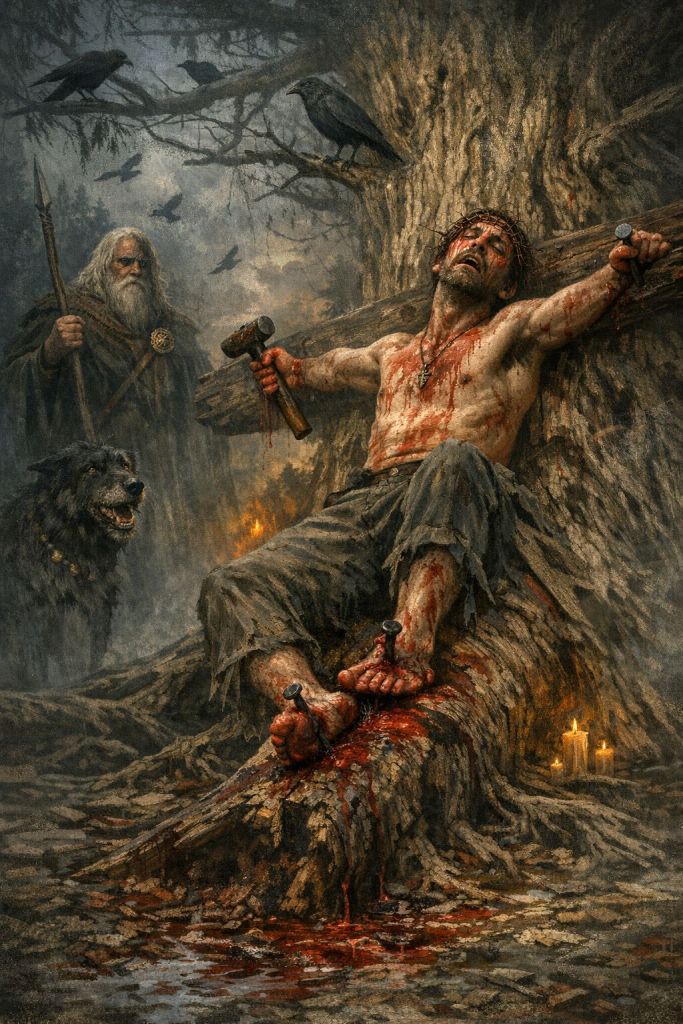
An old man walked down the path, and his dog came with him. The wolfhound looked as aged as his owner with flecks of gray in its fur. It’s tongue rolled out lazily, and it grinned as it paced alongside its companion.
I’d recognized the two. The old man was our neighbor from a mile down our place. I’d found it funny that they commuted by foot for such a distance, considering both their ages.
“What do you think you’re doing, ye langer?”
The voice was low and gruff, like a growl with an Irish accent. Axe in hand, I hesitated. Had I caught that correctly? I hadn’t noticed the old man’s lips move as he spoke.
“What did you call me?” I was unfamiliar with the term, but it sounded insulting.
“You heard me.” Then, I froze. My suspicion was justified in believing the voice did not come from the old man, but the dog.
“Yeah I can talk. Fuck you.”
The old man grinned. “Quiet, Failinis. He’s new at this. I’m Lugh.”
The dog, growled.
“What are you doing, Lad? He’s got a point, you know.”
I stood perplexed. I thought the action was obvious.
“I’m cutting down this tree.”
The old man clicked his tongue, and grinned a toothless smile. “And why are you cutting it down?”
“Because, he’s an idiot,” said Failinis.
The old man glared, and the dog cowered. “Stop insulting him.”
“I’m cutting the tree for wood,” I said. “So we can keep warm come winter.”
“A respectable cause, but we can’t let you do that, Lad.” He glowered at me, like he’d done to his hound. “Besides, there are other trees.”
“If it’s such a good cause, why can’t I? It’s my tree, in my backyard, on my land.”
The man smiled again. “Because it’s unethical as you people call it. Is that a challenge?”
“Yes,” I said asserting myself. “It is.”
“Well, from the looks of you, you’ve got Irish blood. So I don’t doubt your fury for a minute. Because you’re a son o’ mine I’ll treat you better than the others.
“This–here–tree, is not your tree. It is mine. It was planted a long time ago, before your bastard conception, or your Pap’s birth, before your grandmother was fucked by that Irish sailor.”
“This, oak?”
“He doesn’t even know what kind of tree it is!” yipped Failinis.
“This yew! I transported it here from over the great drink when it was a sapling, from a country not unlike your own. Long before the lawmakers bickered, the proprietors and their bullshit regulations, and the property managers partitioned the allotments.”
“I didn’t know that,” I said, my countenance softening. However, the story had quite a lot of holes; and that put Lugh’s age as a centenarian into question. “Well, I’m sorry but it doesn’t change the fact that the tree remains on my property, and as such I have the right to cut it.”
“It’s just a warning, son. But if you cut it, you’ll end up with a lot more than you bargained for. And I’d be the one to tell you.”
I’d resolved to cut another tree that day, only for the sake of Lugh’s sentiment. When the trees dwindled, I’d reconsider it. But that wouldn’t be for a long time.
*
My wife had been happiest that summer; her novel was almost complete. I’d started working at a community college again, and felt alive.
That summer, she got pregnant with our son.
In bed, I’d felt her stomach for kicking. “Honey,” she said.
“What,” I said. I stroked her hair, the swirls of red. I noticed a gray strand, supposed stress to be the contributor, and said nothing.
“I didn’t tell you something,” she said, “I should have.”
“I’d like to hear it.”
“Well, it’s just that there’s this.”
She lifted her nightgown so that her belly showed. “It’s a tattoo.”
The impression was of a spiral, a cyclical wheel wound about her navel. The marking was green, the flesh raised, like a lesion.
I reached to feel it.
“Don’t touch it. It hurts.”
“Like a branding? How long have you noticed it?”
“Ever since I’d seen the obstetrician. I knew even before then. I felt it deeply, instinctively. I’ve been pregnant before; that was a long time ago. I just don’t want to lose it, again.”
I embraced her, comfortingly. “It’ll be alright.”
“There’s something else,” she said as her eyes welled with tears. “I’ve been having dreams.”
I gave her a quizzical look.
Last night I dreamt I fell into a fire. I screamed, and yelled but I couldn’t move. Like my body was paralyzed. I could see my skin blacken, my skin turn to ash–until my own voice sounded strange in my ears. I woke up, in a cold sweat.”
Over her shoulder, I hid my troubled expression. I stayed up late that night, doing research on the internet. I searched the encyclopedias, in the basement. I disregarded the dust, and the cobwebs, until I found the book I’d been meaning to find.
“A Translation of Myths and Celtic Symbols”
At the beginning of the book, was a similar symbol: the dreaded tattoo that haunted my wife, and her dreams.
I read on.
The emblem was a solar cross, a pre-Christian symbol with roots in many cultures: Indian, Greek, and Norse. __
*
We’d called my wife’s lesion The Mark. After inquiring about it to the obstetrician, and finding it posed no harm to her well being, we resolved that it was nuisance.
The day came, when at last our son was born. He arrived with a caul: weighing a hefty ten pounds, and a dollop of red, being a follicular crown about his head. Like my wife, he had blue eyes. But I could not see my countenance in him.
“He’s got it,” said the midwife. Her voice was uneasy, trembling. “The birthmark, on his forehead.”
I’d chuckled. It was one of those unhindered, feigned laughs; how someone could alter another’s worry on wordplay alone. I just couldn’t believe it.
My wife stared at me then, eyes lavish and weary.
We’d named our son Mark and as time went on his hair grew lush and tangled over his brow so that the brand did not show. Sometime during the early years I’d struggled to recall Lugh’s sentiment, though Faintly remembered the yew and figured, that it may have something to do with this. Though In truth, I would not allow myself to believe the superstition.
*
My wife’s novel was published in our sixteenth year. It’s title, “The Fortuitous Nature of a Postpartum Mother,” was allowed multiple installments by the editor. In the course of several months, it had climbed to the summit of fandom. She’d attained accolades from the editors of neighboring magazines. One reviewer, of the Antioch review, had remarked it as,”both sentimental and enlightening.” The talk amidst the papers, was that my wife, Nancy Summers, was to be the next prolific semi-autobiographical fiction writer. And shortly thereafter, before the letters spewed in petitioning her to write a second, her work was a bestseller.
“I’ll be going away,” she told me, “Just for a bit. Taking a flight to New York.”
“For what?” I said. I was excited for her.
“A televised interview, regarding my work. It’ll be a day trip.”
So I kissed her.
My son, who’d played football at the highschool, had surpassed me in height. The coach, and faculty were in talks of making him quarterback.
Even I saw the fruition of my hard work. I’d become department head of English, and published several articles in The Times.
*
However the storm came in April, when the dog died. Then my son broke out in fever. My wife hadn’t returned my calls, and I’d begun to worry. She’s found someone else, I thought. I’d begun to ruminate. Some doctor far off on her travels who drove a lavish sports car, and talked about Dotoskvy late into the night.
I fantasized on this thought, for far too long a time–to the point of fury. I calmed myself, believing in my haste, that I lacked the rationale.
I waited.
*
“Its an acute stage of multiple sclerosis,” the doctor said. “We can deter the symptoms for a time, but as is the case with neurological disease, deterioration is incremental, yes—but forthcoming.”
It is a troublesome thing for a teenager to face mortality. I didn’t tell him the diagnosis, not until I felt ready. But soon the fester of anxiety became too much. But even still, I couldn’t bring myself to tell him.
Instead, I took the axe from the woodshed, and hacked. In my fury, I don’t know for how long I went at it, but by the time I’d finished the sun had long fallen. I’d felt the exhaustion: the pangs in my hands, a fasciculation in my shoulder.
But the truest, and most searing of pains began after: once I’d set the axe down on the table in the shed.
It began with a hand cramp, and then a violent jostle–a shaking throughout my core. The force rattled my teeth. I heard a shrill sound, a pealing of gothic bells. No matter what, I could not drown it out. It was then that I saw it.
The dreaded mark, emulsifying, and manifesting on the back of my hand. It grew, singing flesh up my arm and to my chest. After a minute the burning sensation localized at my solar plexus, directly above my heart.
To describe in words, what happened next would be a trifle all its own. The truth is, I am not certain to this day what transpired, but in that moment I remembered Lugh’s words. They resonated in the ambience of the mind, and festered.
In that instance, my body was not my own: neither to commandeer, neither to think. I was only a witness of what it did. My mind was a careful observer, affixed at times with panic and sheer disbelief.
I began with the hammer. My hands fished for it in my toolbox, the sea of sharps and gadgets. Then my fingers sought nails–not the tacks meant to hang picture frames, but rivets like one would find scattered about on an abandoned railroad.
With these items I set off into the yard, hurriedly and crazily until my foot hit the trunk I’d cut. The impact, I’m sure had crushed my toes in their shoes but I could only wince, and continue the arduous, mysterious work at hand.
Working on their own cognition, my hands removed my shoes, and socks. I could see the damage to my right foot, a mangled mess of bone protruding from sinews of flesh. Still my hands worked mercilessly.
Like a brute, I sat on the tree trunk. I crossed my feet, the right over the left. Clutching the rivet, my hand glided above them. It aimed with precision, hovering. With my left hand, I raised the hammer above my head.
Then, with a brutish force the hammer fell. It missed the rivet but hit my toes, only to render them mincemeat.
Still, my arm raised of its own volition and when it struck this time I heard a munching sound. With the next, a geiser of blood met my lips. It took a total of ten blows for the stake to puncture the flesh of both feet. It took several more to adhere them to the freshly stained bark of the yew.
I screamed at the gore of it, but began the placement of the second rivet.
Then the thought came. I was crucifying myself.
then a whistle came from the forest, and a snarl with it. It was Lugh, and Failinis.
Give it here lad, said lugh and at once my hands obeyed. They offered up the hammer, the object of my penance.
Hands up! And my hands obeyed.
The old mans hands quivered as he placed the rivet in my palm.
Every time, said Lugh. I hate doing this. It hurts me just as bad. But,
Smack
I’ve grown accustomed
Wham!
To the pain. You people never learn.
thought you were kings, didn’t you?
With the last blow his impaling had been complete. Both his hands were adhered to the boughs of the felled tree.
_heard this sniffing sound below, and saw the dog lapping up the blood.
Failinis!
Sorry, said the old hound. It beats the shit you give me.
I should have never saved you, Failinis. Left you in that castle, I should have.
Lugh turned to me. “ you got rope?”
I couldn’t answer, for to do so would be to acknowledge his subjugation. Instead i focused skyward, my eyes set on a particularly grating sirostratus.
I could only nod.
Is the rope in the shed?
I nodded again.
Dig! Said the old man, the dog obeyed promptly at it at an alarming rate. Once the old dog had dug the hole to his master’s satisfaction, the poor thing collapsed in the muck and mire.
Now help me hoist him up!
The old hound looked at Lugh, a cowardly, saddened expression. Then he left, disappearing into the shed. He returned with thick rope, the kind I used as a replacement for Bungy chords.
With strong hands Lugh pulled the dirt from the soil
[To be continued]
 The Nebuchadnezzar magazine
Leave a comment